The Human Worker as Civilizational Nexus
A myriad of forces threaten the integrity of the human person. Every one of them converges on the same place—work.
My new book, The One and the Ninety-Nine, is out now. Some of the essay below is inspired by its Chapter 8, on the changing nature of work and its social dimensions.
There is a small machine on my desk in Washington, D.C. It runs AI agents around the clock, humming quietly, sending me intermittent messages about what it is “working” on. It drafts. It summarizes. It reasons, plans, reports back. By some definitions, it works harder than I do.
But nothing it does is doing anything to it. It is not becoming anything.
I sometimes look at it and think: That machine has never worked a day in its life.
Explaining why I believe that—and why the kind of work humanity does both now and in the days ahead will determine the future of our civilization—is the purpose of this essay and of the publication it announces.
Lewis Mumford thought the machine age did not begin in a factory. “The clock, not the steam-engine, is the key-machine of the modern industrial age,” he wrote in 1934 — and the clock began in the monastery. The Benedictines rang bells to call monks to prayer at the appointed hours, and to keep the hours of worship they invented the habit of mechanical time. Then the habit escaped the cloister. The clock moved from the bell tower to the counting house, and time became money. But the first machine was built to order work around prayer.
Every age has been forced to ask its own version of the question: What is the relationship between work and the whole of life, and what kind of work should we be engaging in?
In 1891, Pope Leo XIII confronted the “new things” of industrial modernity in the encyclical Rerum Novarum. It was published at a time when technology, capital, labor, politics, and ideology had been rearranged faster than the moral imagination could grasp. Rerum Novarum tackles the great social questions related to these changes—namely, how to defend the dignity of the human person in a world newly organized by industrial capital, wage labor, and the logic of production.
By the 1930s, amid depression and mass unemployment, with the stock market having recently collapsed and the lure of communism strong, the social questions had sharpened into the “worker” question. The Catholic Worker movement, with its publication sold for a penny and its houses of hospitality, emerged as a concrete witness to the dignity of labor and the irreducible worth of the person in an economy tempted to treat workers as expendable.
By the 1980s, networked computation opened the Information Age, and the question shifted again: What happens to the human person when information becomes the dominant material of economic and cultural life? How can we prevent or inoculate ourselves from becoming commoditized? And with all of the world’s information soon at our fingertips, what is even worth paying attention to and pursuing?
Today we stand at the dawn of the Intelligence Age. AI does not merely store, transmit, or organize information. It imitates the activities we have long associated with human intelligence: writing, a particular form of reasoning, designing, composing, advising, judging, creating. And so the old question returns in its most radical form yet. Not only, “What will happen to jobs?” but: What is work for? What is the human person? What forms of intelligence, creativity, responsibility, love, and calling cannot and must not be outsourced to a machine?
And yet this powerful new technology comes with enormous promise and possibilities for humanity: it has the potential to cure diseases (and already is), solve difficult problems in math and physics that are unlocking the mystery of the cosmos, and help humans make connections across domains of knowledge that they wouldn’t otherwise make. While there are uses where these technologies are obviously dangerous—people seeking therapeutic or spiritual advice from the machine, for example—there must be a way to navigate this world without resorting to knee-jerk reactions, fear-mongering, or a failure to grapple with real problems that AI might be able to help address.
Pro-tech and anti-tech narratives are each creating problems of their own. There is a need for serious discernment—a kind of discernment which starts, in some sense, with spiritual freedom. That means a willingness to examine our conscience and the communal discernment of the communities of which we are a part; to chart a new path forward that is not driven by various forms of ideological and economic capture, or a compromised moral imagination. I have also noticed the twin pressures of coercion and conformity creeping over into the Church, where dogmas become prudential judgments and prudential judgments become dogmas.
Grounding discussions in work—and in specific forms of human work—cuts through the abstract ways that technological advancement is so often spoken about. It’s generative to think seriously about the application of AI for a writer vs. a surgeon vs. a blacksmith; I’m not sure another panel on the nature of consciousness is helpful, or at least has diminishing returns relative to the real anxieties and practical problems human workers are facing on a daily basis. Addressing them is one of the things we will do here.
There is no doubt that a myriad of forces threaten the integrity of the human person today, and let’s be sober about them. Depersonalizing technology masquerades as something you can personalize: your AI, your feed, your profile. Political energy flows toward tribal “alignment,” sorting people into categories and types, prioritizing positions over the development of relationships. Religiosity increasingly comes in the form of content, separating word from action. The family is strained by economic conditions that make it harder for parents to manage the demands of work and home—with many opting not to start families at all. A dearth of beauty and aesthetic intentionality makes everything feel the same, driven by weak mimesis rather than the aliveness of the spirit. And artificial intelligence fragments the head, the heart, and the will—while not even getting the head part right. (Intelligence is identified with ratio, the kind of reasoning a computer is good at, rather than the human mode of knowing, which includes a connaturality, a communing with a thing. This is why sex was a way of “knowing” in the original Hebrew of Genesis: Adam knew Eve.)
We are siloed, thinned out, and fragmented, and all of the focus on “progress” is obscuring the death of the human spirit and the death of work. But we cannot afford to labor in vain any longer.
I believe the sphere of human life where all of these forces play out—and where we must focus our attention with great urgency—is work.
The discourse so far has focused on disruption to the job market, with Anthropic CEO Dario Amodei saying that 50% of white-collar entry-level jobs could be eliminated in one to five years. We don’t know if that’s true yet, and the economic stakes are real: our social fabric could be torn as wealth disparity increases. But this kind of talk, even if he’s right, is superficial. It equates work with a “job,” and it equates the coming disruption with merely economics rather than the one that is more likely: a disruption at the level of the soul.
The deeper questions are about the nature of work itself and a vision of the human person that respects the greatness of the human spirit and our lofty vocation to participate in the creative power of God as creatures made in His image and likeness. Through work, we don’t just make more; we become more.
An appropriate vision of the human person, and of human work relative to machine work, will give us a framework for evaluating technology as something that is both a tool and an environment—and it will help us ask whether that environment is fit for the human person who wants to become fully alive. As we do a better job of defining and defending a specifically human mode of work, we will clear up some of the confusion surrounding artificial intelligence: the loose, theologically-tinged language that anthropomorphizes it on one hand and flattens the human person to an interchangeable cog on the other.
Work has been and always will be a central part of what it means to be human, ever since we were given the command to cultivate the earth in the book of Genesis. Technology will never eliminate this need. I understand that there are plenty of Baconian Christians out there who see technology as possibly eliminating human suffering and even “reversing the effects of original sin”—I once heard a Silicon Valley entrepreneur cite the removal of the pains of childbirth as proof. I’m all for technology that lessens human suffering. But it will never eliminate it, and learning how to suffer well will remain something every person must be prepared to do.
Work is also a deeply spiritual activity. Ora et labora, work and prayer, was central to the Benedictine tradition because work, properly understood, can become a form of prayer. That is the only way to “pray unceasingly,” as Paul implores the early Christians. Prayer can be active. Work must be sanctified. And to be sanctified, it must be done with human excellence. One should not give to God gifts that represent shoddy labor. We give the gift of our best—to one another, and to God.
The Three Dimensions of Work
Work doesn’t have just one dimension, but at least three.1 I’ll lay out the three major ones here.
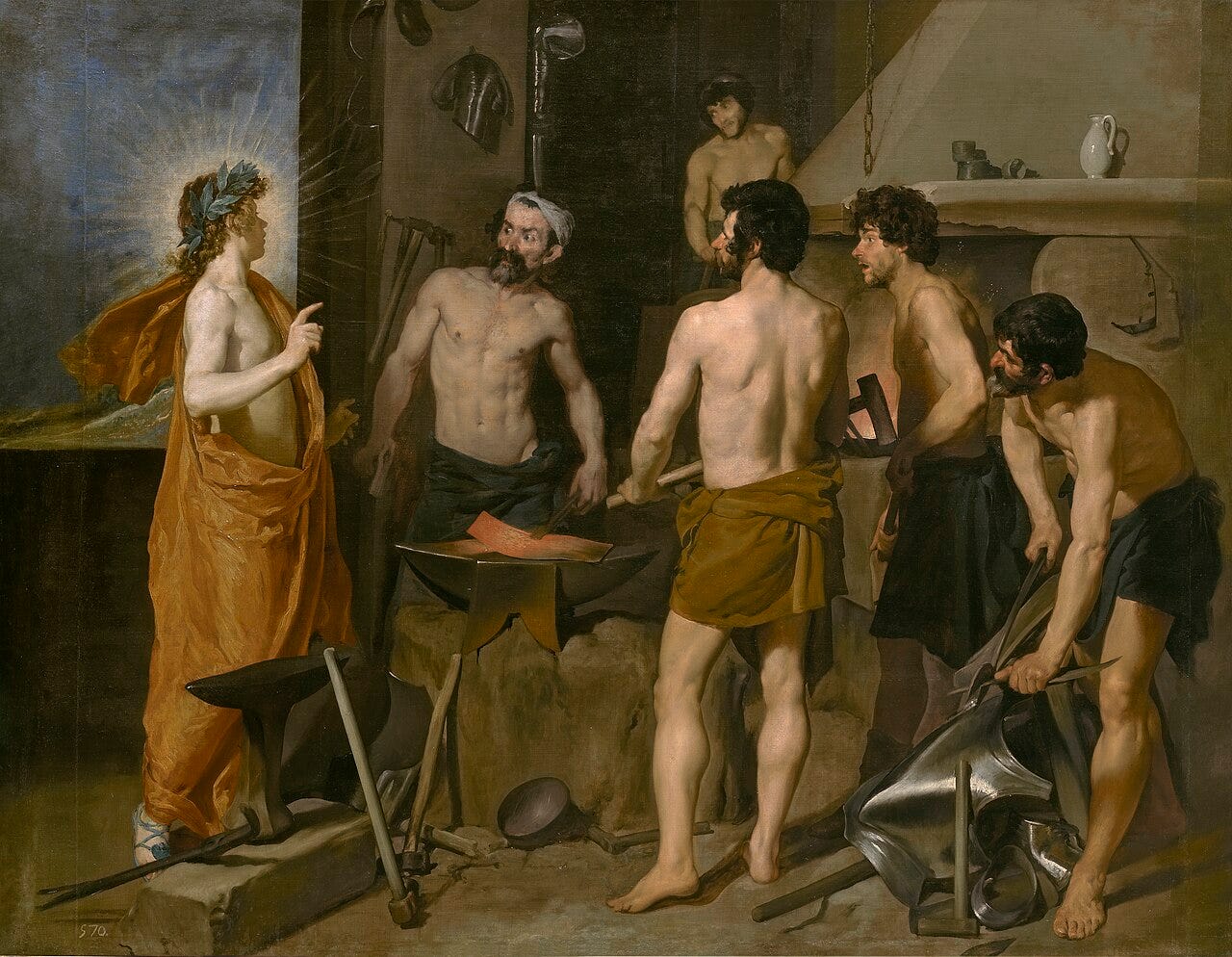
The objective dimension everyone knows: it is the output of the work, the thing you’re actually doing or making. The blacksmith makes a tool. The making of the tool is the objective dimension.
But work also has a subjective dimension, which is more foundational. The subjective dimension is what the work is doing to the worker. By engaging in his work, the blacksmith may develop bodily fitness and specific virtues such as diligence, patience, and fortitude.
Different kinds of work form persons in different ways—office work is very different from landscaping in how it shapes a human being. And not all work is equal in its ability to form persons well. We have placed such importance on the objective dimension of work—just look at the way AI is spoken about, in terms of everything it will be able to “do”—that we’ve neglected the subjective dimension almost entirely.
We must evaluate technologies by the subjective dimension too: how are they forming, or de-forming, the human person? Are they building virtues, or stripping them away? The economy is for man, not man for the economy; likewise: technology is for humanity.
We are not its servant, nor is our fundamental task to “advance” technology to the point where life becomes a technological project rather than a human and spiritual one. Life is a mystery to be lived, not a problem to be solved.
Third, work has a transcendent dimension. When asked why they were crafting a gargoyle on the very top of a great cathedral—so that absolutely nobody on the ground would ever see it, centuries before planes or skyscrapers—the workers replied simply: “God sees it.” And therefore they made the best gargoyle they possibly could. Work can be sanctified. Work done with excellence is a gift—not just to ourselves, but to others and even to God. The loss of the transcendent dimension of work has led to the loss of magnificent and magnanimous projects like the building of cathedrals, or whatever their modern-day equivalent is, in which we may not live long enough to see the completion of the thing we’re building.
The Opening of the Human Spirit
In 1987, Allan Bloom wrote The Closing of the American Mind, arguing that modern education was leading to moral relativism and a collapse of civic virtue. But as the cost of cognition trends toward zero, is there not an opportunity to probe the most essential human questions—metaphysical and spiritual questions that everyone will have to begin asking, and in many cases already are? The closing of the American mind may very well lead to the opening of the American Spirit—and indeed, the human spirit, worldwide.
America has a particular responsibility here. As the country now clearly leading the development of the most powerful technology in history—now routinely described as “God-like”—it falls on Americans to develop spiritual lives capable of wielding this power well.
But before such world-historical concerns, it would be good to return to the most intimate parts of life.
The family is the most important unit in our society—a communion of persons, where souls are formed and where we learn the value of work. Work is meant to support the family and help it thrive; it should not prevent the formation of a family, or generate so much anxiety and disorder that it rips one apart.
The Church’s idea of a “living wage”—which all humans should be able to earn through their work—is not about people being able to earn enough money to support a specific ‘lifestyle’; in its original conception, this idea was ordered to the good of the family. It is not a living wage so that people can live out their fantasies; it is meant for the development of this most fundamental societal unit and all of the many goods that flow from it. This goal need not be achieved through wage-earning labor alone: if a technology like AI can help the family flourish by reducing tedious or soul-crushing work, it should be embraced. Again, the abundant life of the human person is the measure.
Today, in many ways, technology is thinning out family life. People are “alone together” with heads buried in phones. The rites of passage that used to happen in the family and through work are migrating to thinner forms online: ubiquitous pornography has replaced the normal avenues of sexual discovery; “finding a tribe” happens in the digital realm before a person has developed a solid sense of who they are; and young people join a public “discourse” that asks nothing of them, curating feeds that inoculate them from the friction essential to maturity. The family has suffered as a result.
Many of the assaults on the family could be defended against—even counter-attacked—if work is re-framed as a social activity as much as an economic one, and if we evaluated its effects by what it does to human relationships, starting with the family.
Work and Beauty
Work is also the sphere in which design, aesthetics, and art are shaped. Because it forms the human person, it is the primary place—after the home—where we learn sensibilities and develop taste. Here I do not mean taste in the superficial sense of “noticing something cool before other people do”, the anti-mimetic tastemaker who starts trends or is looked to as an influencer, but taste as something ordered to reality itself: developing a taste for the true, the good, and the beautiful.
There is a deep connection between aesthetics and ethics and the quality of human life itself. Work is one of the primary places we discover it. Ask someone who has worked in poor conditions!
The data center is not ugly by accident; it is a monument to work conceived entirely in the objective dimension—pure output, no formation, no one becoming anything. The human person must work in a way that contributes to the building up and beautification of the world.
The Works of Mercy Are Work
We often separate acts of charity from work: “philanthropy,” “service,” “giving back.” And yet these acts are among the most important human works. The Christian tradition calls some of them works of mercy, physical and spiritual: burying the dead, visiting the imprisoned, feeding the hungry. If you’ve ever done one of these things, you know that it’s real work.
We have romanticized these activities, as if people do them for the warm and fuzzy feelings they produce. But they are a form of human work that we cannot rely on machines to do for us—especially not when calculating, utilitarian approaches to profoundly human problems risk tending toward justifications for euthanasia and other assaults on life. Machines cannot judge whether life is “worth living”, and in fact the very question betrays the problem. Life is worth living. I have always been struck that Bishop Fulton Sheen titled his primetime broadcast in the 1950s “Life Is Worth Living”, because it originally seemed too basic and uncreative to me—but I’ve come to see it as the perfect title of the show. Even back then, he recognized it as the most fundamental message to share, repeatedly.
My father has dementia, as many of you know. More than once, when I’ve discussed his care with an AI, its framing drifted toward cost-benefit analysis—weighing the burden of his condition against the value of his remaining life. Never mind that he helped give me life, and raised me. Caring for him has produced nothing the machine could measure: no output, no deliverable, nothing "accomplished." But it has worked on me more than anything else in my life. It is the subjective dimension of work in its purest form—and it is precisely the form of work a machine cannot register, because a machine cannot be changed by what it does. What is the end of this utilitarian thinking? I can’t see the exact path, but I can see that it’s dark.
We must expand our conception of work to include these most human activities: one person serving another, even for no economic profit. A world in which spiritual profit is not valued cannot be sustained. In such a world, work turns inward, toward zero-sum games with no telos beyond the immediate opportunity for gain. That is not work fit for immortal souls.
The unhelpful distinction between “for-profit” and “not-for-profit” is part of the confusion. A deeper understanding of work—and of the way all of it should be profitable in some form—will help humanity exercise its gifts more creatively, without channeling everything into silos of “revenue-making” and “service.” We will come to see ourselves as building an economy of value in all its forms, in which progress is measured as much (or more) by how well we care for our most vulnerable citizens as by how many new millionaires are minted in Silicon Valley.
Human Work
My friend Andreas likes to tell the story of his unexpected encounter with a silverback gorilla on a safari in Africa. Andreas is 6’9”, a former Swiss Guard. A big dude. But the gorilla was far bigger—and it identified Andreas as the greatest threat because he was the largest member of the group. During their face-off, Andreas remembers marveling at the gorilla’s likeness to himself. The great beast eventually backed off once he knew his family was safe, but Andreas couldn’t stop thinking about him for days. At one point, he had a revelation: despite sharing so much of the same DNA, one of the key differences between him and that gorilla was that the gorilla had never worked a day in his life.
The machine on my desk shares none of my DNA, and it imitates me far more convincingly than the gorilla ever could. But the gorilla and the machine have this in common: neither works, because neither becomes.
The gorilla grows—larger, stronger, dominant—but only into what a gorilla already is. Its life is a closed circle. Human work can break the circle: it can become a participation in a life greater than our own, drawing us upward through what we do. It isn’t always. That is precisely what must be recovered.
Work that is intentional and spiritual—human work—belongs to us alone. The monks knew it every time the bell rang. That is what is at stake.
What’s Coming
The Cluny Institute will soon be launching The Human Worker, a new publication on vocation, formation, technology, and the human person. Because you already read my work here, you’ll receive it automatically; you can unsubscribe from it any time without affecting anything else. I hope you’ll stick around, because this is the most exciting development of Cluny so far, and my own writing will be oriented around this most fundamental question. You’ll be able to find much of it in The Human Worker—and we’ll be seeking others who want to contribute to the mission.
Its mission is the same one the Cluny Journal has had from day one:
The hand of the Lord was on me, and he brought me out by the Spirit of the Lord and set me in the middle of a valley; it was full of bones. He led me back and forth among them, and I saw a great many bones on the floor of the valley, bones that were very dry. He asked me, “Son of man, can these bones live?”
Thank you for reading.
Order The One and the Ninety-Nine, out now.
The distinction between the objective and subjective dimensions of work comes from John Paul II's 1981 encyclical Laborem Exercens, which remains the most profound modern treatment of the meaning of human work.


