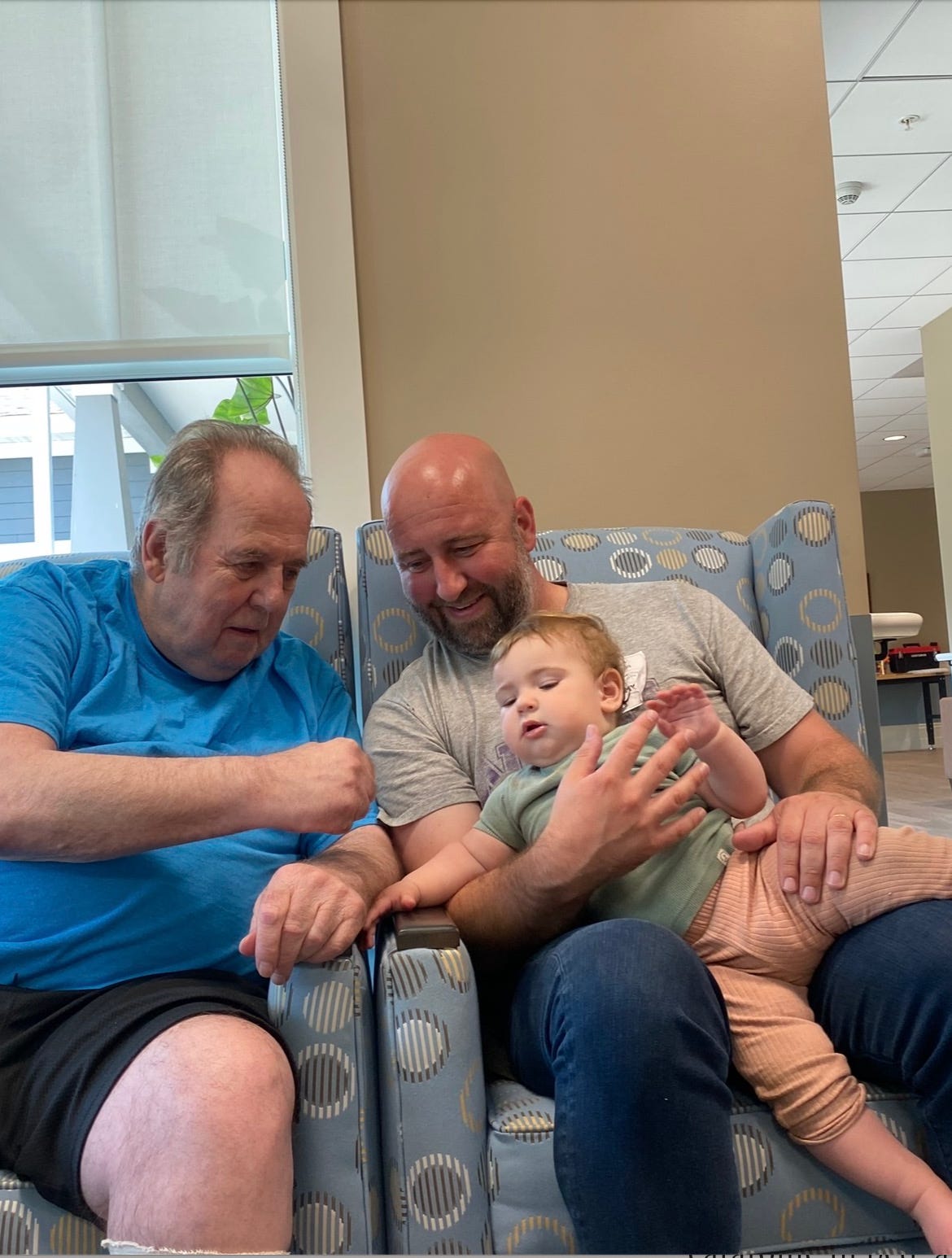
What My Father Gave Me by Forgetting
He is losing his memory. In losing it, he reminded me that the mind was never a solitary thing.
When I was thirty-nine, I was traveling out of state and grew concerned when my mother stopped responding to texts and calls. My aunt and uncle went to the house and discovered a nightmare that would change my life forever. They found my mother catatonic in bed, and my father puttering around as if nothing was wrong.
He thought she was taking a nap. In reality, my mother had suffered a sudden, catastrophic health decline—and my father was disappearing into the fog of undiagnosed Alzheimer’s disease.
I returned home in shock to peel back the layers of a miserable onion. My mother had been my father’s sole caregiver for more than five years, since the disease had become debilitating—but there had been signs going back more than a decade.
Her fear of confronting Alzheimer’s was too great, so she ignored it as his faculties slipped away. Then, when she needed him most, when urgent medical attention could have saved her life, he didn’t have the presence of mind to respond. By the time I arrived, it was too late. She was dead in a week.
The extent of his disease became clear only in increments. When the ambulance took my mother to the hospital, the paramedics didn’t realize that my father couldn’t be left alone for more than five minutes without risk—that he might put a metal bowl in the microwave, which by then my mother had taped shut. He would need constant care.
In The One and the Ninety-Nine, I recount the story of my arriving home on the day my mother was hospitalized to find him chain-smoking the cigarettes he had found in my mom’s purse. My dad doesn’t smoke, and neither do I. But on that day, it was so absurd—and in the moment, so oddly funny—that I asked him for a couple, since I’d heard that my mom was stable. We sat there smoking together for ten minutes, in the brief moment before we left for the hospital.
That is the particular vertigo of the only child: there is no sibling to call, no one to run things by, no one to ask whether you are seeing what you think you’re seeing. I often felt as though I were going crazy—alone, watching a very slow car crash. My parents had been so afraid of losing the life they’d built, the memories they shared, the person he had been, that they would sooner barrel blindly into catastrophe than ask for help. The few times I pleaded with them, I was met with promises to deal with it—later.
I learned everything I could about Alzheimer’s: what causes it, what it does to the people who have it, what I might do to help. I came away with more questions than answers. It is a complex, mysterious disease of the mind—the dissolution of memory and meaning even as the soul burns bright. There are treatments that, given early, can slow it and in rare cases even restore some function. But the doctors confirmed what I feared: for my father, that window had closed.
And here, in the throes of it, I found something I can only call a gift. It was too late to save my father’s mind. But there was still time to save my own.
Through his illness, and through caring for him, I felt called back to something almost primordial in myself—a deeper conscience. I needed to take better care of my health, yes. But more than that, my attention. I began to see the feeds I scrolled as their own disease of the mind: an endless timeline on which every moment blurs into every other, indistinct, nothing quite distinguishable from anything else—not so far, I realized, from what my father must experience. And I became painfully aware of how thoroughly we abandon the old, and especially the demented. We forget them. We forget them, in part, because they forget. We begin to mirror their forgetting.
But the deepest reckoning was with community. As an entrepreneur, I like the feeling of controlling my own destiny, and I had to come to grips with the fact that, with aging parents, I controlled nothing. They were adults, in fact and in law; I could not make them do what they would not do for themselves. Coercion was not the answer. But neither was abnegating my responsibility as a son. So what, practically, could I do?
The answer arrived, as these things sometimes do, on Sunday. The Mass reading was from Sirach: My child, help your father in his old age, and do not grieve him as long as he lives; even if his mind fails, be patient with him; because you have all your faculties, do not despise him. I prayed for the grace to live those words. And then I noticed something about how the trouble had surfaced in the first place.
The only reason I had known anything was wrong was that I’d run into my parents’ parish priest, who told me he hadn’t seen them at Mass in some time and wondered how they were. That is what a thick community does. The parish is grounded in something that transcends politics, hobbies, consumption, content—and so it notices an absence. It comes looking.
Too many of the communities I’d belonged to over my life had been thin. They didn’t tolerate difference. They didn’t summon anyone to grow in integrity. They would not have been there in my hour of need, much less my hour of dying. They rewarded the thinnest possible forms of belonging—having the right enemy, learning the right words to humiliate him.
Such communities, which thrive online and across our increasingly artificial world, reward whatever strengthens the status and the power of the group. They turn everything into totalizing politics. Inside them, we become shape-shifters. We never learn the art of belonging well; we learn only how to belong at any cost.
It turns out my father had been schooling me on the difference all along, simply by what he refused to forget. As his mind failed, the memories that held on longest were the ones most deeply embedded in him—and every one of them was a small circle of people. His brothers from the 101st Airborne, the men he’d jumped out of planes beside. His fellow parachutists. His Teamsters. His golfing buddies. The regulars at the store he bought and worked the last fifteen years of his life. The thick associations were the last to go. Many of them he carries still. The mind discards a great deal under siege; it clings hardest to the people who knew it.
And he has kept his humor. One thing I learned quickly is that my father now engages in zero social calculus, because he is entirely unaware of what anyone thinks of him. If someone were angry with him, he wouldn’t hold it for more than a few seconds. “It’s not all bad being me,” he told me once, with a glint that suggested he knew exactly what he was saying, “…because there are a lot of things that are not worth remembering.”
There is more wisdom in that than he knows. It is so easy to fall into entanglements that warp our priorities away from what matters most and toward what matters only in the vanishing moment. Some people help us remember who we are. Others help us forget.
My father has lost the ability to tell them apart—and in losing it, he has reminded me to attend to the difference while I still can.
Because our memories, and our very sense of who we are, do not live inside our skulls alone. They live in the space between people. The first time someone said of my father that he was “no longer there,” I understood that he is very much there—because I am there. His memory is not what it was. But his existence, and his dignity, were never his to hold onto by himself.
We are more than one another’s keepers. We are one another’s seekers.
There is an old story about a shepherd who leaves ninety-nine sheep to go after the one that wandered off, and who, finding it, comes home rejoicing. I used to think the parable was about the sheep. I’ve come to think it’s about the shepherd—about what it does to a person to refuse to let someone be lost. We must go and seek what is lost. And if we look hard enough, and long enough, we will find it, and carry it home, rejoicing.
In my case, what was lost—what I keep going back for—is my father. I do it for him. I do it, now, for the daughter who arrived shortly after that catastrophic day, and for her younger sister now, so that they will grow up knowing what it looks like to be sought.
And I do it for myself, while I still have the faculties to choose.
This Father’s Day, my father will not remember that it is Father’s Day. It doesn’t matter. I will remember for both of us.
That, in the end, is the whole of it: a mind, unlike a brain, is not a solitary thing. It is something we engage in with one another, and with the world. A mind, unlike a brain, is made to dance. And we can dance even with those who no longer remember the steps.
My new book, The One and the Ninety-Nine, is out now. This Father’s Day essay is drawn from its theme. You can pick up a copy here.