


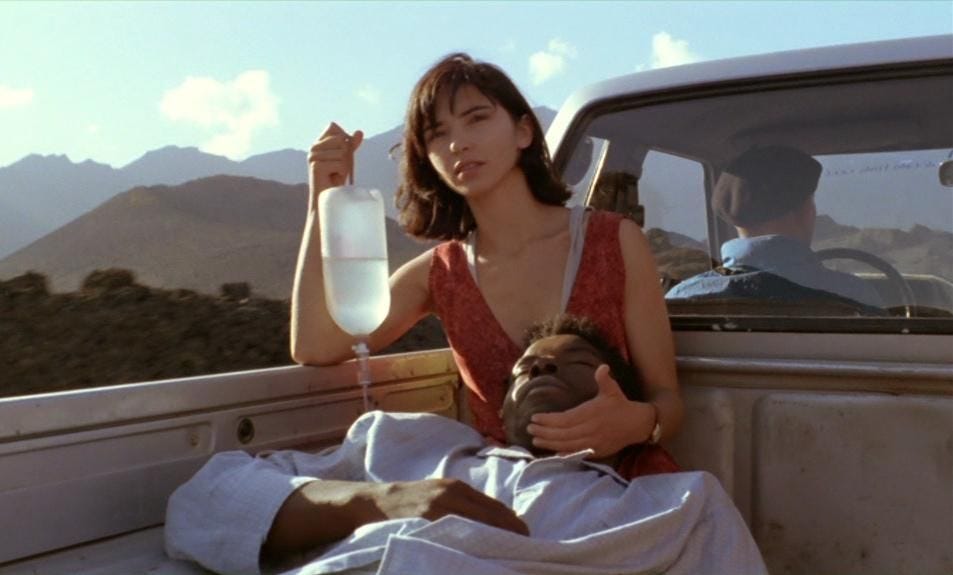
If you work in film, I’d like to invite you to a small party that I’m co-hosting in New York City on Nov. 19. I’m also announcing a new venture: over the next four years, Cluny Films will fund sixteen short films. More on that below.
The documentary film space is ripe for innovation, as Nathan Fielder (You Can See Everything) has just shown the entire world.
While it’s interesting to push the limits of the documentary form while depicting the relational dynamics of a convicted, fraudulent entrepreneur—and it was certainly entertaining—it’s far more important to push them toward a deeper vision of the human person and the kind of relational dynamics that have the potential to heal our broken society.
I doubt many readers here will need convincing that Hollywood has played a major role in the malformation of the human soul. Hollywood is mimetically exhausted.
And yet it still plays a significant role in the formation of the moral imagination, in which conceptions of the human person and our destiny are amplified, disseminated, and sold.
Hollywood will remain important as a metaphorical city—perhaps not as constitutive of culture as the triad of Athens, Jerusalem, and Silicon Valley, but still powerful and to be respected. (By “Hollywood”, I mean the actual structures of power that exist in and around Los Angeles, CA, which have played a critical role in American filmmaking since the early part of the 20th century.)
It’s no secret that Hollywood’s power structure has been shaken in the past two decades; AI is only going to accelerate that disruption. Nobody truly knows what might emerge.
We don’t need to, though. There is now a window of opportunity to revisit assumptions about both form and content, to inspire a new generation of filmmakers to think bigger and probe deeper, and to begin forming a new kind of talent network that specializes in the art of mystagogy, or the art of leading others into mystery.
We are looking for artists who want to work on projects that open and elevate the human spirit to what is truly good and beautiful, but who do so through an adherence to reality—a dogged determination to tell the truth at all costs, and to trust that it is through the truth that we, and our audiences, are set free. We begin by entering into the real—which is not different from entering into mystery—and let new things emerge.
This is different from “responsive” art, which is art that responds to other art, or art that is made to communicate an “idea” or ideology, to send a “message”, or differentiate itself from Hollywood. The problem with that approach is that it’s not primarily responding to the real; it’s trying to position itself in the marketplace before it even begins, and this ultimately kills the spirit of the work itself, in the same way that a parent can kill the spirit of a child by telling them what they have to do when they grow up before they have a chance to wrestle with God themselves.
I see this most often in the various associations I am invited to be part of, or the invitations I receive that over-emphasize and overweight the identity of the person or group—whether it’s a political identity, a religious one, or something related to one’s state in life. All of the adjectives (for example, “We’re Christian filmmakers who…”) tend to make what follows over-determined.
Rather than focusing on the excellence of the outcome, the focus shifts to identity.
I realize that social clubs in which people share some political or religious identity can be great places to meet people and find a sense of solidarity and support—they have their place—but they are generally environments that make it difficult to produce the most excellent work.
That is partly because projects that emerge from ecosystems like this are often calibrated to what increases status within the group and not to what confers status outside of it. Sometimes this is done as a coping mechanism (“they would never accept or understand our work”) and other times out of insecurity or naivety—I encounter this problem with writers all the time—but the point is that the approach is self-centered and self-conscious, and it ultimately makes it more difficult to make something real because the starting point is corrupt.
It is a form of identity politics that has been played more on the political right and more in religious circles these past five years than it has been on the left or in secular circles. It’s not even identity politics; it’s identity-driven creation. Identity-driven art.
I believe that the focus should be on the other, completely; the focus should be on the human person, the reality we are trying to engage, on the truth. Not on grievances, which are often just driven by envy.
This may be strange to many people, but I fully believe closely held “values” can get in the way of great art. I obviously don’t think that having values is bad—there are many values I hold dear, and try to respond to daily (I don’t ‘have’ them). I’ll articulate a couple below. The problem is when a person wants to put all of their values into a big stew and serve it up to the entire world, warning them that they might not like the shards of lamb bones and intestinal tract flavors that they’ve never developed a palate for. In other words, why not focus on one thing that doesn’t require adherence to an entire creed or worldview to understand—something that has a universal language, something deeply human, something that can be communicated in the art itself? Something that can stand on its own.
I have been asking myself as honestly as possible which deeply human truths are being neglected in today’s world—which ones make people so uncomfortable that they often provoke defense mechanisms and ridicule? Trigger misunderstandings and guilt? Which truths are dangerous? Too dangerous to speak of or live out openly?
Those are the truths that might make for the most fascinating explorations and art. Those are the themes that I want to explore in my own work. There are plenty of people exploring the comfortable ones.
One of those truths, I believe, is the absolute necessity of mercy in human life. Humans can’t live without it. If we were only given what is just, we would not be able to function as people or as a society. There will always be times when we are in need of others’ mercy, and times when we are called to show it to others. And more fundamentally, we are invited to develop a merciful heart: an inner disposition of mercy toward the least of our brothers and sisters.
In the 25th chapter of the Gospel of Matthew, Christ gives concrete examples of how people will be judged for the life they lived.
“…for I was hungry, and you gave Me nothing to eat; I was thirsty, and you gave Me nothing to drink; I was a stranger, and you did not invite Me in; naked, and you did not clothe Me; sick, and in prison, and you did not visit Me.’ Then they themselves also will answer, ‘Lord, when did we see You hungry, or thirsty, or as a stranger, or naked, or sick, or in prison, and did not take care of You?’ Then He will answer them, ‘Truly I say to you, to the extent that you did not do it for one of the least of these, you did not do it for Me, either.’”
In the Christian tradition, these six things—feeding the hungry, giving drink to the thirsty, inviting in the stranger, clothing the naked, visiting the sick, visiting the imprisoned—along with a seventh, burying the dead, which is depicted powerfully in the Book of Tobit—have traditionally been referred to as the “corporal works of mercy”. They are corporal because, unlike the spiritual works of mercy (there are a traditionally seven of those, too), the corporal works pertain to the body.
In a world becoming increasingly dominated by powerful and disincarnate AIs—and in which reality is mediated to us by ever more screens and apps—it is an apt moment to go back to the most fundamental realities of our existence, including the fact that each of us has, or more accurately is, a body infused with a soul.
The body is the definition of The Real. We all have one. Some of us take better care of it than others, but all of us live our lives with a body whether we like it or not, as much as we’d prefer to be angels. Our bodies are constitutive of what it means to be human and what it means to have a human intelligence as opposed to machine intelligence, for example. Our bodies mediate the entire world to us. I can really think of no more important topic than the body.
It is also a portal to the mysterious—because when you touch another human being, you are touching an immortal soul. That is not just why sex is sacred; it is also why religious ideas disassociated from the care for bodies—the bodies of human persons—always morph into bad ideas. It is the realm of gnosticism, in which the body is merely a prison. And gnosticism is a philosophy that many are embracing, whether freely or by mimetic assimilation.
“The body, in fact, and only the body, is capable of making visible what is invisible: the spiritual and the divine.”
—Pope John Paul II, General Audience, February 20, 1980
The corporal works of mercy combine the reality of the body with that most fundamental act of charity: showing mercy to another person through a bodily gesture.
There is something so concrete and specific about the seven works that they can’t be faked.
You can fake yourself into believing you’ve forgiven another person, for example—but you can’t fake feeding them or visiting them while they’re in the hospital, or on their deathbed. These corporal works of mercy are not so ripe for delusion!
They make real demands of us, and we often fail.
When we witness these acts of mercy, though, or when we engage in them ourselves—whether we are on the giving or the receiving end of the act—our hearts are moved. We are transformed. We begin to live out in our bodies what we had previously only professed in words.
In a content-saturated world where even Christianity can begin to be fueled by “vibes” and an overly emphasized sense of ‘interiority’, the corporal works of mercy call us out of ourselves—into the real world, and toward those who are in most need of our mercy, but whom we may have justified not helping in any number of ways, sometimes by twisting ourselves into mental and spiritual pretzels at the service of worldly concerns.
That is why, over the next four years—beginning in January—a newly formed division of The Cluny Institute, Cluny Films, will be funding a series of short, experimental films that tell powerful stories about the corporal works of mercy in the real world. I’m aware that a film series on the works of mercy, funded by an institute like ours, could look like the very thing I just criticized. The difference is the starting point: not our identity or the filmmaker’s, but the act itself—a hungry person fed, a prisoner visited—which needs no creed to be understood by anyone who has ever needed mercy.
I think it’s fitting to announce this new initiative here because the corporal works of mercy are fundamentally anti-mimetic acts: they are usually done without the expectation or even possibility of reciprocation. (I say “usually”, because Luke 16:1–9 is the story of mercy being practiced for future gain.)
To tell these stories well, we are going to be finding and funding a network of talented writers, storytellers, and filmmakers who will produce four short films per year, along with writing and opportunities to actually mobilize and engage in acts of mercy together—because it is shockingly hard to know where to start, given that the world hides and protects us from these opportunities. They don’t make for good politics; but they do make for magnanimous souls, and that’s what we’re here to help cultivate—with your help.
This will be a filmmaker-led project in the sense that we’re going to be identifying the most talented filmmakers with the best stories to tell, and giving them a generous amount of money to produce the film they want to make. We are structuring the deals so that filmmakers own their work, and are properly incentivized to develop these shorts into a variety of future projects.
If you work in film, please request an invitation ASAP to a small gathering I’m hosting in New York City with Cluny’s Deputy Director, Jordan Castro, and several other members of our team. If you don’t but know someone who does, please forward them this newsletter. And if you’re not a filmmaker and just know a great story that we should consider finding the right filmmaker for, I’d also like to hear from you about that. If you’d like to come to the NYC gathering, please fill out the form in the invitation link above; for anything else, you can just reply to this email.
I’ll have much more to share about this project in the coming months. For now: I just want you to come hang out with me in New York City this month. There is nothing like November in Manhattan.
A new aesthetic will emerge out of new relationships. That is the only way.
Hope to see you soon,
Luke
I’ll miss you by two days!