


Friends,
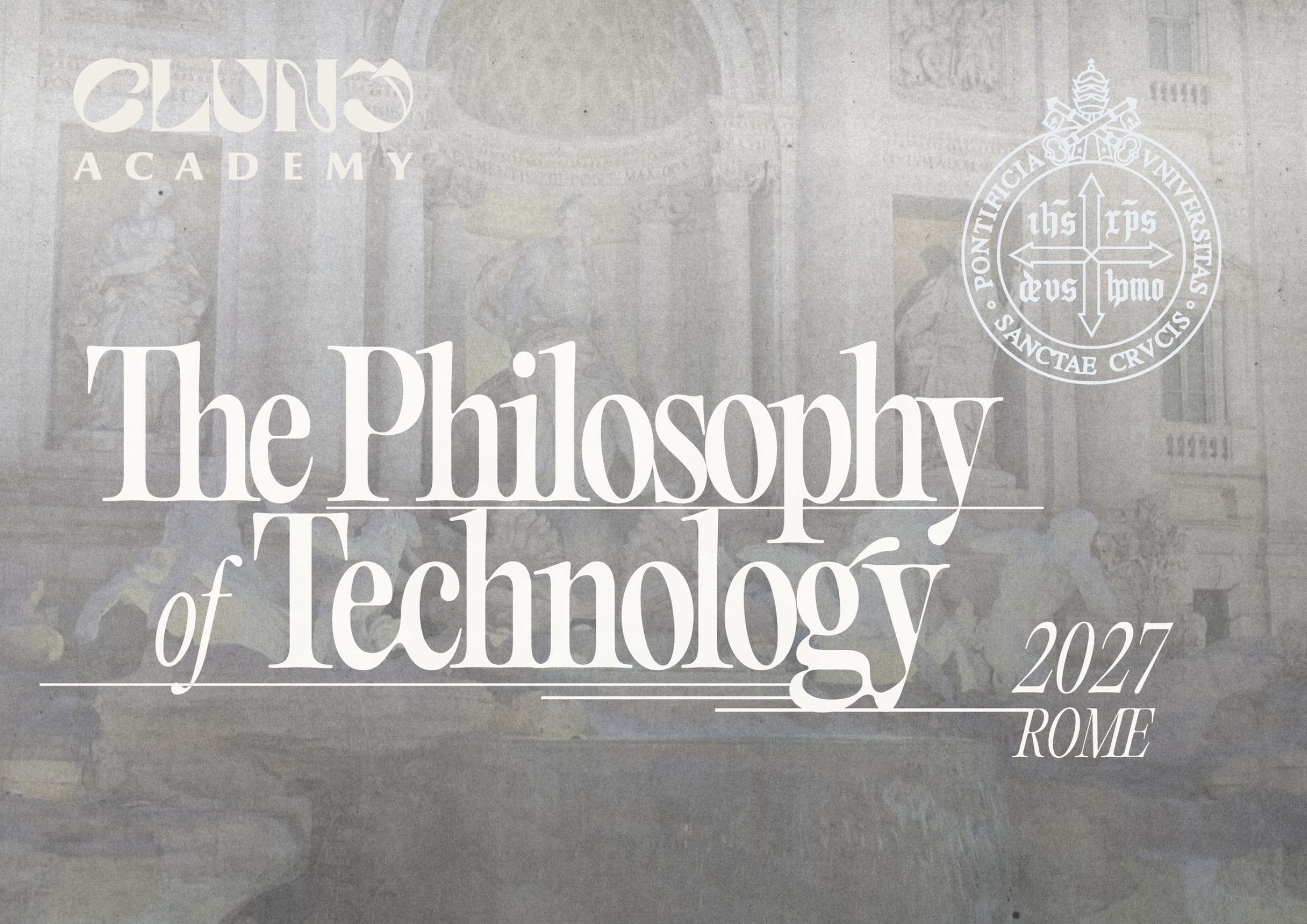
I’d like to invite you to join me in Rome, May 30-June 3, 2027, for an intimate seminar I am hosting called “The Philosophy of Technology.”
I’m trying to keep it small, so I am going to use an application process to make sure the right group is convened.
I’m looking for an interesting mix of practitioners, builders, thinkers, writers, and generally curious and talented people across a diversity of domains—roughly fifteen people—who would like to go deep with me and several special guests over the course of four days in the Eternal City, accented by shared meals and meaningful excursions.
(You will be required to watch La grande bellezza before arrival. I’ll show you where to get the best cacio e pepe and listen to late-night jazz, and I have a few special surprises in store.)
The intangibles are hard to describe, and I won’t even try. I encourage you to learn more here (including schedule, curriculum overview, and extensive FAQs) and consider applying if this sounds like an experience you’d like to be a part of.
Why this experience? And why now? I’ll start with the practical and easy part: my old professor, Don Giulio Maspero, and I planted the seeds of this idea while I was visiting Rome with my family earlier this year. His area of study is relational ontology. We talked over lunch at his favorite trattoria in Trastevere about the importance of restoring the relational in the way we approach the questions concerning technology.
Those who have read my recent books—especially The One and the Ninety-Nine—already have a sense for how I’m navigating these questions. My conversation with Father Maspero convinced me that I hadn’t even scratched the surface. So I began working on a new book, subtitled “Technology as Soulcraft,” and going deeper than the discourse, back to primary sources and approaches to the most fundamental questions about technology qua technology. AI is just the latest manifestation of our technological progress. It is a pivot point, a leap—maybe even ushering in the so-called ‘singularity’—but that doesn’t mean that we can understand it without understanding the first principles. On the contrary, they’re more important than ever.
I started looking for the right people, in the right place, to probe these questions with and to share my research. I quickly learned that what I am personally looking for just doesn’t exist. I would have to, as I have done many times in my life, put my money (and effort) where my mouth is, and build something that I think should exist. That is the genesis of this collaboration between me and Santa Croce, the same university I studied at for three years when I lived in Rome.
I spoke there in March in front of about 1,000 university students from around the world, and it brought me true joy to go back into the same auditorium where I was once a student listening to lectures on Trinitarian theology. The conversations that I had with some of those students after my talk, late into the night, convinced me that I needed to do something to fill a gap that I know I’m not the only one seeing.
To say that I’m unsatisfied with the discourse around technological progress—and the many talks/panels/conferences/lectures that have come into being by organizers simply throwing the word “AI” in front of a generic title, like appending “dot com” to your company name in the late 90s—is like saying I'm unsatisfied with Olive Garden.
It may be able to satiate, but it can’t elevate.
Secular attempts to grapple with the serious metaphysical and anthropological questions introduced by a technology like AI are inadequate because there is a fundamental religious illiteracy in the approach—first principles are glossed over, and religious language is smuggled in through the back door in utterly unhelpful ways.
But if you think “Religiously-Branded AI Forum XYZ” is any better, I have bad news for you. First principles, if you’re lucky, will be all you’ll get. And there is often a hypermimetic focus on AI mixed with virtue signaling that goes a long way toward explaining how credulous much of the Church's engagement with the AI labs has been.
As I sat in the last one of those gatherings that I was invited to, I turned to my friend Michael and said that it sounded like the conversations about AI had been generated by AI. Which is my way of saying: where is the Spirit? Where is the unexpected? It blows in ways and in directions we know not and may never predict—and yet so many are obsessed by predictions, prediction markets, and over-determined questions often beginning with the word why.
What is a positive vision of technology? It’s certainly not just “pro-human”—that seems like an incredibly low bar. We must have a greater vision of humanity to aim for, but it need not be one that we invent. It has already been shown. This means our path begins and ends with Christ, with the Alpha and the Omega. Dante had to invent a word for it: trasumanar, to pass beyond the human. The transhumanists are reaching for something real; they just can’t reach far enough.
If you'd like to be part of the 2027 cohort, the button below has everything: the flow of the curriculum, what to expect, and how to apply. Applications close January 30.
And if you feel a flutter of nerves, unsure about whether you can make it work, or what you might encounter there: coraggio!
No sign will be given to this generation except the sign of Jonah. Will you dare come down into the belly?
Happy Thanksgiving,
Luke

The hand of the Lord was on me, and he brought me out by the Spirit of the Lord and set me in the middle of a valley; it was full of bones. He led me back and forth among them, and I saw a great many bones on the floor of the valley, bones that were very dry. He asked me, “Son of man, can these bones live?” —Ezekiel 37:1–3