Last chance for discounted Cluny Conference (“Life Abundant in an Artificial Age”) tickets—15% off good through the end of year with coupon code ‘antimimetic’. Full-time position now open: Manager, Social Media and Community.
“Once we have surrendered our senses and nervous systems to the private manipulation of those who would try to benefit from taking a lease on our eyes and ears and nerves, we don’t really have any rights left.”
―Marshall McLuhan
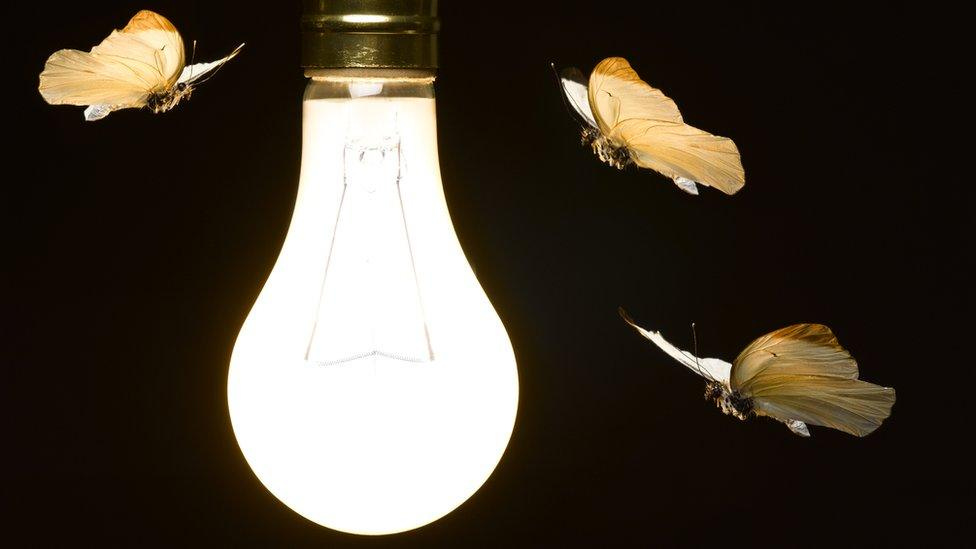
Moths evolved to navigate by celestial light. Artificial light hijacks that instinct—and they spiral. Technology introduced changes into the environment that they can’t adapt to fast enough.
While none of us like being compared to moths, it’s hard not to see our current predicament as somewhat similar. We’re not adapting fast enough—morally, spiritually, intellectually, physically—to the bright, artificial light that is Artificial Intelligence.
The Internet ushered in the Information Age, in which people quickly became exposed to an abundance of information without having developed the proper skills to discern noise from signal. That age is effectively over. A.I. has brought us into the Intelligence Age—but the catch this time is that machines are the protagonists. They already outperform us in many dimensions of intelligence, but not all (I’ve already written about the difference between ratio and intellectus—a difference that will only grow in importance).
Modern education is largely the product of John Dewey, America’s leading pragmatist and architect of progressive education. In 1897, as he was about to shape the American education system for the next century, he wrote: “the school is primarily a social institution. Education being a social process, school is simply that form of community life in which all those agencies are concentrated that will be most effective in bringing the child to share in the inherited resources of the race, and to use his own powers for social ends.” Education quickly ceased to feel dangerous and became a system for learning what the society thought you should know to advance its own democratic ends and equip you for the best jobs. The “social process” for Dewey was more about removing friction, not creating it. If we all know and agree on the same things, we can get along in polite society. And in my view, no individual contributed more to the borification of the American education system than him.
We spent a century training humans to be robots. Now that the real robots have arrived to take those jobs, we are finding that the "borification" of education has left us dangerously ill-equipped.
The Law of Adventure
As far back as the 1970s, Marshall McLuhan noted that students in Watts who had dropped out of school were saying they did so because they learned more on the streets than in the classroom. It was a wild, exciting place where there were countless opportunities to learn how to adapt and grow in a challenging environment every day. This is when the term ‘street smarts’ began to grow in popularity. It is a form of democratic counter-intelligence—knowledge earned through exposure, risk, and human complexity rather than classrooms.
This only accelerated in the 80s with the broader introduction of the personal computer. There was so much more valuable information online—and outside of the classroom—than inside of it that it rendered the classroom setting sterile, weak, and unexciting. For decades, teachers have struggled to accept this reality. I believe there is a Law of Adventure that holds across all teenagers: they will naturally flow to the place where there is the greatest sense of adventure, unless they succumb to a form of learned helplessness and become hollowed out and dead inside before they are exposed to one—before a great quest ignites a fire inside of them, and they activate their powers of perception and put them to good use finding secrets, discovering new ways of doing things, exploring fresh terrain and carving grooves in fresh powder. These are the things they crave.
This is partly why I believe the humanities are going to experience a bull market in the age of AI—at their best, they are adventures into the heart of the human person, not mere ‘information’, and that’s why they are inexhaustible treasures that will begin to seem even more important in the age of the machine.
A Bull Market in the Humanities
I believe we are about to experience a massive renaissance in the humanities, inside and outside of universities—but especially outside of them.
I believe the rise of A.I. will bring us another Dostoevsky in the next decade, the advent of new genres of fiction and non-fiction, and an American Marian event that will rival Fatima or Lourdes, or maybe more like Medjugorje. (This last prediction may seem discontinuous with the other two, but it has to do with the shift in religious consciousness that will accompany this paradigm shift. Whether the claim of an appearance will be dubious or authentic, I don’t know—but I think something mysterious is coming. I’ll dedicate a separate essay to this.)
The education of the future must be an education of the senses—improving how we see, taste, hear, feel, and smell. Technology has the effect of either dulling the senses or amplifying one at the expense of the others. It also has the effect of bringing new senses into being.
I believe, for instance, that we are developing a new parasocial sense—and have been over the past thirty years—one that is previously unknown in the history of humanity. Whether that sense is beneficial to us or not I don’t know. I’m not sure what evolutionary purpose it might serve yet other than making us all hyper-mimetically aware of social dynamics and vibes on the Internet and beyond, and the strange ways that is bending back on our in-person encounters.
The education of the senses is an education in what Iain McGilchrist identifies as the right hemisphere’s mode of attention—an openness to the whole, unmapped territory of experience. The left hemisphere, like our new machines, merely manipulates the map. In the Age of Intelligence, the greatest danger is not that machines will conquer us, but that we will succumb to their way of seeing and mistake the map for the world.
I hope that we’re able to pair the Age of Intelligence with a competing—or perhaps even complementary—Age of Perception. If we can do these two things in tandem, we’ll have the Renaissance that we desperately need.
The latter only comes about if education begins to focus less on information and more on cultivating those senses of perception: the arts and poetry are about learning how to see and feel. The culinary arts help us learn how to taste and converse with others in a full sensory, embodied, incarnate experience. Great music teaches us how to hear. Nature teaches us many things, including how to smell.
And call me crazy, but I actually believe that learning how to notice the smell of flowers and trees is directly related to our ability to develop a nose for bullshit.
That’s because there is a nexus at which all of the senses converge, the sensus communis, and this organ of perception is what allows us to sense and perceive important things across domains. As an antidote to our hyperspecialized form of siloed education, those who develop their senses in this way will be the next generation’s best artists, writers, thinkers, and entrepreneurs—not just those who know how to ‘leverage AI’, but those who combine the power of perception with the Age of Intelligence.
Students should be trained to be more like James Bond and Sherlock Holmes than archivists of dead facts. They must be given adventures, challenges, quests. Send them out into the city on a mission that allows them to generate the right questions rather than come back with the right answers. The adventures must feel risky. They must be rites of passage, which upon completion confer a more solid sense of self and a deeper engagement with reality. Make education dangerous again.


