The Book As Live Wire
On nonfiction, AI, and reader experience
Before you read this: If you enjoy my writing here, the best thing you could do to support my work is to pre-order a copy of The One and the Ninety-Nine: Forging Identity in the Age of Social Contagion, which comes out on Tuesday, June 16. To the extent that you’re on social media, or write your own Substack, I’d be extremely grateful if you’d consider spreading the word this week. If you’re in NYC, come join me in Brooklyn on Tuesday for a party to celebrate.
Nonfiction Will Be Disrupted
I was on a train from NYC up to Rhode Island to give a talk on Saturday when I was floored by this recent blog post from Tim Ferriss, author of The 4-Hour Workweek, one of the bestselling nonfiction authors of the past two decades. It’s titled “Has AI Already Killed How-To Nonfiction? Sales Trends, My Personal Data, and What It Might Mean for the Future.” He opens with this chart of his book sales over the past three years.
He tracks the trouble starting precisely around the time ChatGPT was released in late 2022. It’s a particular problem for Tim, because he writes “How To” books. But why read a book on “how to” do something when you can just ask ChatGPT, or your favorite model, and get a highly personalized version of advice, customized to your unique circumstances, that may be synthesizing the same ecosystem of ideas anyway?
In short, I buy Tim’s thesis: those kinds of books are going to be in serious trouble. Books that are overly prescriptive are going to suffer. Tim finally concludes:
“The market for information is collapsing into the chatbot. The market for transformation—for sitting with one mind, at length, on a subject it has bled for—might just get smaller, weirder, and more interesting. I’d bet on it. In a way, we’re reverting to the earlier days of the Internet.”
This is one reason I have been anxious about the form of nonfiction itself while writing The One and the Ninety-Nine. Not just what the book says, but what kind of experience the book creates.
I have to take Tim’s idea further. Transformation doesn’t happen through content alone—that is, from merely transmitting what I know into what I've decided you should know. That, sadly, is what much of the education system of the past 125 years has been based on, ever since John Dewey published hisbod “pedagogic creed” in 1897, which turned students into gatherers rather than the hunters they are meant to become.
I believe that part of my job as an author is to turn readers into hunters. In other words, I don’t want anyone passively reading a book that I write. But that’s incredibly difficult to pull off, because we’re all habituated to the “form” of the nonfiction book, which is, as you know, a series of words on a page which these days, more often than not, come in a sequence composed of various elements: a Gladwellian story, a study, an insight, an anecdote, another study, another insight, study, study, study, insight, insight, insight, interpretation, a story, maybe some bullet points at the ends of chapters to summarize.
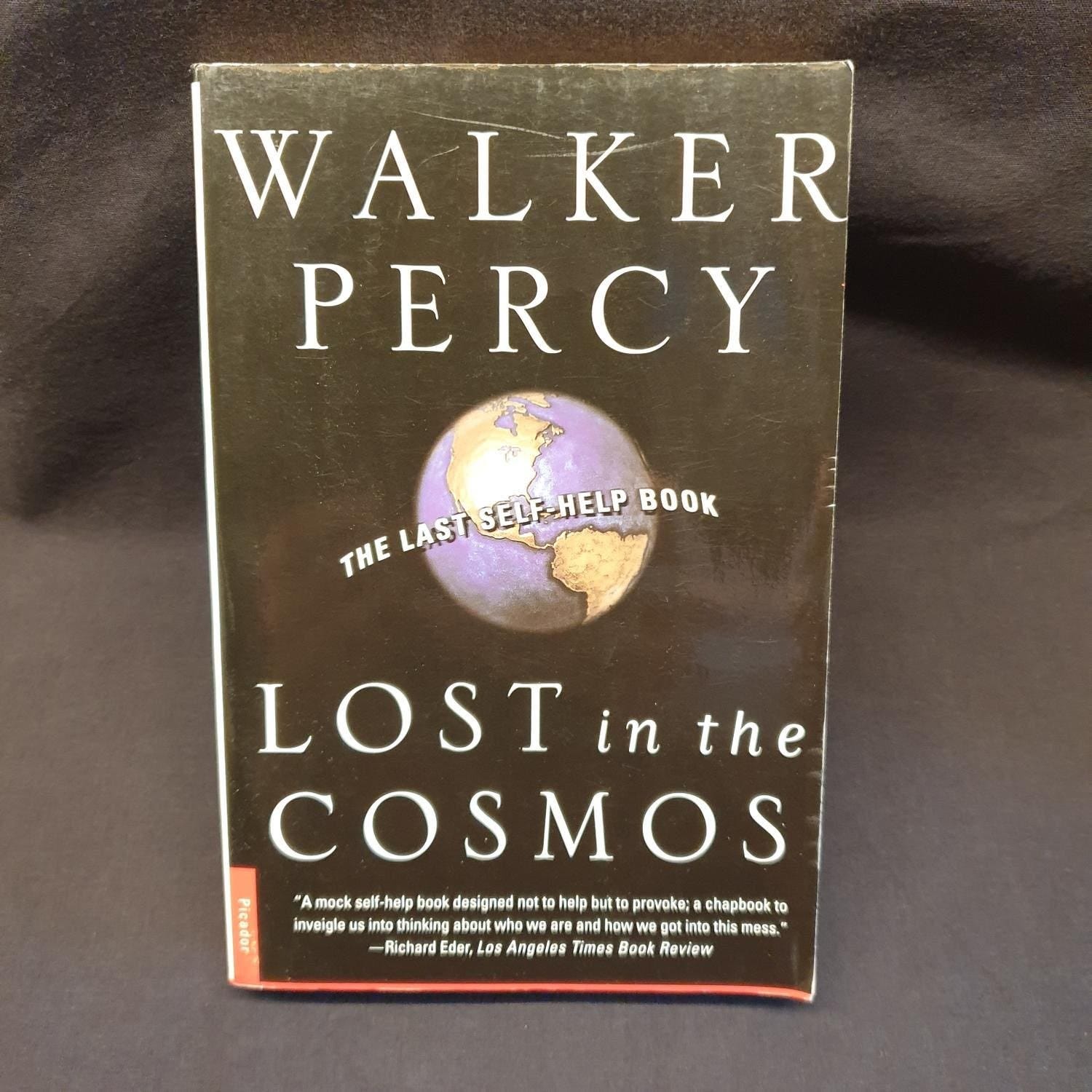
I appreciate those authors who have pushed against the limits of form in the nonfiction book—the forms of fiction are far more diverse—the way that Walker Percy did with his book Lost in the Cosmos, published by FSG back in 1983, two years after I was born. The book is composed of “thought experiments”, quizzes, and other things that test the reader and break them out of the mode of mere reading—to something more experiential. His quizzes looked something like this, but I’ve adapted this one to my own book:
Why is it easier to join a movement than to hold a conversation with yourself? (select only one)
A. Because movements offer pre-packaged identities and you left your interior life somewhere in middle school.
B. Because you’ve been trained to view solitude as a glitch in the system, not a necessary condition of personhood.
C. Because you can like and share a movement, but your soul doesn’t have a social media profile.
D. Because if you actually asked yourself what you want, you might realize you don’t know—and that terrifies you more than being wrong with the crowd.
E. None of the above. (But you’re still hoping someone else will tell you the right answer.)
A book is a book. It has a particular form. It’s also a cultural object, meant to situate people and stimulate conversation, whether you’ve read the book or not. In fact, an important skill is learning to talk about books you’ve never read. And I don’t think the form of the book is going away anytime soon. But there is very little testing of form in books, and especially nonfiction books.
They should dislocate the reader at certain points. They should be strange. They should be a form of mystagogy—not the communication of facts or “ideas”, but an invitation to explore a mystery. They have to speak to the heart as much, if not more, than the head; they have to move people at some deep level.
AI writing may impress us, assist us, even clarify things for us. But it rarely wounds, awakens, or convicts us, because its words do not come from a life.
Many people rightfully practice the wisdom of moral repugnance when they read AI writing about personal experience, because they sense it is using “unreal words”—words that don’t ring true because they are not spoken from the depth of lived experience. That is why it feels thin. This is an encouragement to you to write the thing you might be afraid to write, to be vulnerable, and to take the kinds of risks that only an embodied human can take.
To my fellow authors, especially if you write nonfiction: I think there needs to be a revolution that goes beyond Tim’s. Nobody needs another ‘insight’ given to them by another person (everyone could stand to study some Lonergan on that point), but everyone could benefit from writing that acts like a live wire to the soul. I have skin in the game, as you know. Over the past couple of years, I tried to write a book like that. I hope I succeeded. You will have to be the judge of that.
In the meantime, I’m leaving you with the “Note to Reader” which my editor and I decided to cut from the book, but it provides some extra context behind some of the surprising decisions in the book, and some of the weird things you will encounter along the way that are meant to stir something, leave you asking questions, and ultimately to probe the author, the age, and yourself.
Note to Reader
At the beginning of each chapter and throughout this book, you’ll find probes: something that you can actively prod and poke. The idea is not to explain, but to provoke discovery.
Media theorist Marshall McLuhan used the word probe to describe his way of approaching problems. “Most of my work…is like that of a safecracker,” he said. “In the beginning I don’t know what’s inside. I just set myself down in front of the problem and begin to work.” His method was not linear. “I grope, I listen, I test, I accept and discard; I try out different sequences—until the tumblers fall and the doors spring open.” This is my preferred way of working, too.
Like the unmanned probes we send into deep space, these probes are designed to land in unfamiliar territory—and return something of value. But they don’t return self-contained packets or answers. They open us up to mystery. They make us think: There is more there. In that sense this book is meant to leave you highly unsatisfied, but hungry.
During an interview in 1970, McLuhan remarked: “The problem of private identity vs. tribal involvement has become one of the crosses of our time.” He named a tension but didn’t resolve it—a perfect probe. I’ve spent most of my life in the tension that probe indicates, and I still haven’t resolved it. But perhaps remaining in the tension is the secret inside of the safe. In this book, you will feel that tension.
At many points in my life, unexpected and unforeseeable changes compelled me to reassess my associations: social, religious, political, professional, artistic, and more. I began to ask: in what spirit am I in relationship with others? This question became more important to me as time went on. We don’t just enter into partnerships or join groups. We do so in different ways, with different levels of commitment, belief, loyalty, affinity, skepticism, resolve, or bonds. I began to see, more clearly than ever, how those relationships were shaping me—and how I might need to change in response.
I can’t understand myself without the communities I belong to—yet I am not reducible to any of them. Still, in conversation, people often ask about our affiliations first: what we do, who we know, or who we’re a fan of. And of course the weightier ones: Republican or Democratic? Catholic or Protestant? For or against the war? Pro this or anti that? Those are more than ideological questions. They connect us to others.
Gradually, a new question began to haunt me: Why is it so hard, in modern life, to join a community without losing yourself? Without being pushed toward either total identification or alienation? New technologies, outdated educational models, and the weakening of mediating institutions like religion are changing the way we fundamentally relate to one another. How, in this changing environment, can we ensure that the communities that we’re part of—whether by choice or by fate—are not life-draining, but life-giving?
Between chapters, you’ll find short vignettes from my personal story, called thresholds—because they mark key moments in my life when I crossed over from one way of belonging to another. I hope they will help you see your own story in these pages.
Pre-order The One and the Ninety-Nine. Thank you for reading.


