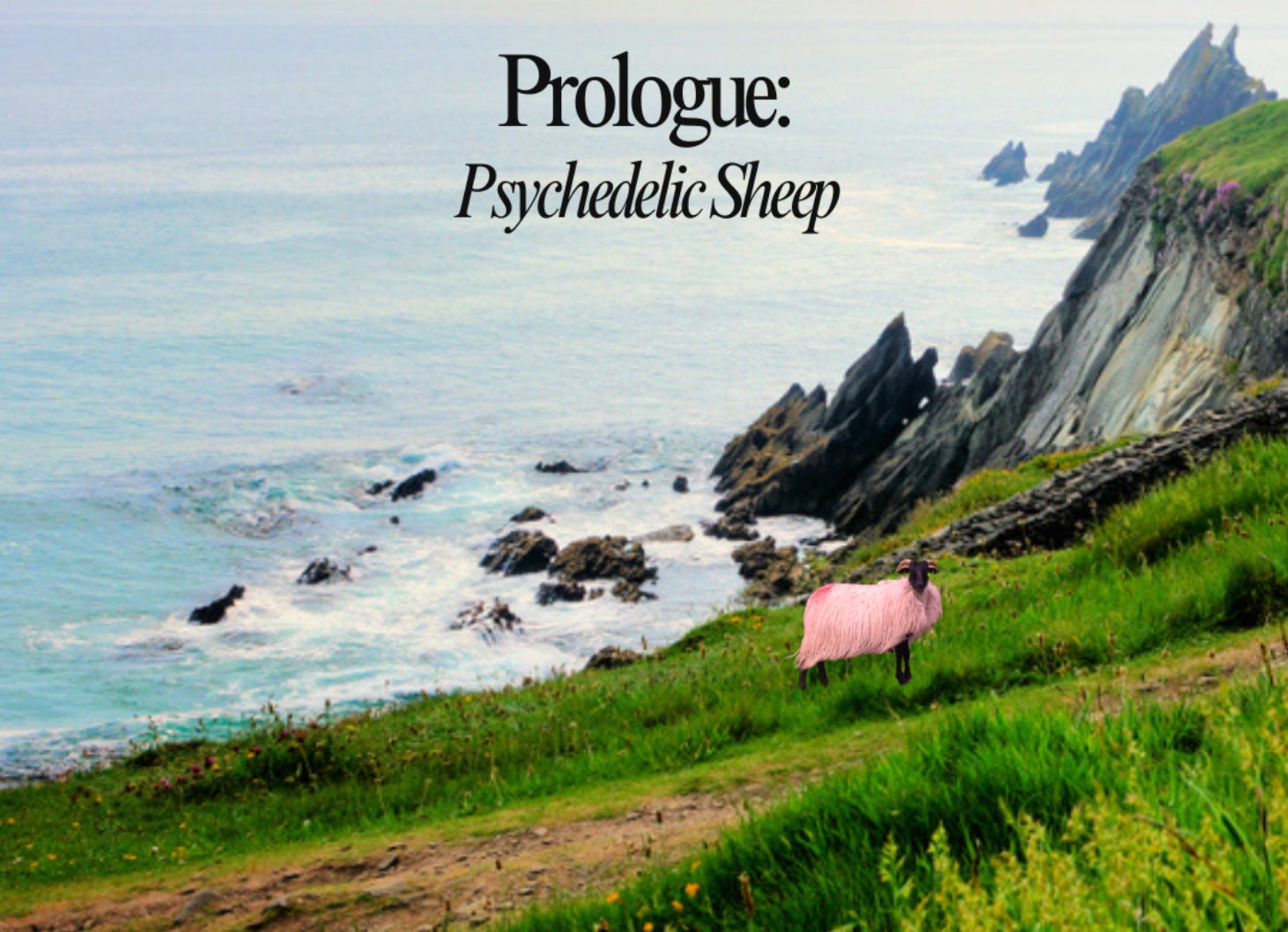
Psychedelic Sheep
On attention, mortality, and the marks that set one life apart from the herd.
The excerpt below is from my upcoming book, The One and the Ninety-Nine: Forging Identity in the Age of Social Contagion—out in less than two weeks, on June 16, from St. Martin’s Press and published here with special permission. You can pre-order a copy here.
In April 2015, my parents flew from West Michigan to Dublin to meet me for a family vacation. I’d been living in Italy since 2013, and this was only my second time seeing them since the move. I missed them, and was excited to explore a place where my dad claimed we might have some roots.
I waited to pick them up from the airport in a rented Volkswagen Passat that I was still getting used to. I was sitting behind a steering wheel on the “wrong” side of the car, navigating the opposite side of the road. I suspected the ride to our hotel would make my dad anxious. A retired truck driver, he had spent his life behind the wheel. He was never comfortable in the passenger seat.
My parents’ faces lit up as they emerged from the sliding doors of the airport, and I hugged them at the curb. As we loaded their things into the trunk, my mom surveyed the luggage, then brought her palm to her forehead and closed her eyes. “Lee, did you forget to take the bag with my laptop in it off the plane?” My dad looked defeated, as if he expected to have forgotten something. “Oh, gosh, honey, I . . .” His voice trailed off. A security officer barked at us to keep moving.
Reassuring them that everything would be okay, I parked the car in the short-term garage and went inside to see what I could do. The arrivals hall was still thinning out from their flight, and a handful of Aer Lingus crew members were making their way toward the staff exit. I had only just begun looking for the lost-baggage counter when I spotted a freckle-faced attendant doubled over in laughter with a colleague. Slung over her shoulder—like a ten-pound Dell bowling ball—was what looked unmistakably like my mom’s laptop bag. I approached her and said, “Hi, I think that bag might belong to my parents.”
“Oh, yes, here you go, love,” she said, handing it over without so much as checking an ID. “You look like your da!” She passed the bag to me and, with a quick grin, turned back to her colleague as if nothing unusual had happened.
And then we were off, on the road to the Dingle Peninsula. My dad was eerily calm as I drove down the narrow roads with a white-knuckled grip on the steering wheel, winding around tight bends with short stone walls on both sides. I clipped too close to one of the walls when the road suddenly constricted, yanking the wheel to keep us on course. My dad didn’t say a word. I didn’t complain, but something was different.
I’ve learned a lot about memory and perception since that day in Ireland. One of the biggest lessons is that we fail to grasp the scale of change when we’re immersed in it.
As an only child, I had a close relationship with my parents. Their yearly highlight was visiting me wherever I lived—New York, Hong Kong, Los Angeles, Las Vegas, Italy. I had noticed, though, that in the past couple of years the trips had started to seem like tests of endurance for them. Changes I would not have noticed if we were together every day became more pronounced when so much time passed between visits: the gentle fading of color in my mom’s cheeks, the slower rhythm of their walking, the disjointed flow of a family conversation.
Still, we had a full slate of activities scheduled for this trip. The first morning we went to see Fungie—a solitary bottlenose dolphin who had showed up in the Dingle harbor in 1983 and was still there. How or why he had separated himself from his fellow dolphins, who typically travel in pods of five to twenty, was a mystery to scientists.
As we rode the boat out, the captain told Irish jokes and got us excited to see this marine mammal. After a long wait, Fungie finally made an appearance and played around the boat for about fifteen minutes. I thought he looked tired—he was estimated to be forty to forty-five years old (for a dolphin, the equivalent of about eighty human years)—but also content, like there was nothing else he’d rather be doing. My mom seemed unimpressed, as if she would have preferred another cigarette at that moment. My dad chuckled and said, “Cool.”
Back on shore, we drank a pint of Guinness at a local pub before embarking on Slea Head Drive, a twenty-four-mile loop around the peninsula that snakes through mountain passes, farmland, and the weathered ruins of stone huts and ancient churches. We rounded a curve to find a vast expanse of blue where the ocean met the sky; in other places the cliffs pressed inward, and the high rock faces appeared ominous, looming over us through the car’s tiny sunroof.
We attempted to make a pit stop for coffee in one of the few towns along the route, but we quickly noticed that nothing—not the pub, not the one-room schoolhouse or post office, not even the church—was open.
We continued on our way. My mom, an artist, told me about her latest glassblowing project and asked if I would be home for Christmas. My dad had been quiet, staring out the window. Then, without warning, he said, “Sorry, pull over.” He pushed the words out between shallow gasps.
At the urgency in his voice, I whipped the car onto the narrow shoulder of the mountain pass. I could see the sea flashing between the rocks. My dad got out and hobbled over to a waist-high boulder separating the road from the cliff. He braced himself on it with one arm and stared into the gravel. “Give me a minute,” he said.
My mom jumped out of the car. “What are you feeling?” she asked. My dad was too ill to respond. I looked inside the car for water. Nothing. “Dad, can you talk to me?” He put up a hand to signal that he couldn’t. Then he threw up.
My mom and I made eye contact, tacitly acknowledging that we knew we needed to get my dad medical care as soon as possible. He would never ask for it or seek it out, but this seemed far more serious than an upset stomach. I googled the words heart attack but was met with a tiny pixelated icon of a T. rex and the message No internet on the screen.
I convinced my dad to get back in the car and, since there was no mobile service, raced back into the small town we had come from to look for help. Still no service, still nothing open. I began running door to door, banging the knockers on the quaint houses that lined the street. My palms were clammy and I could feel my heart thumping in my chest. My mind jumped back and forth between thinking about the urgency of the moment and how strange these tiny houses looked, like small cottages or hobbit holes. I wondered who might live in them.
I never found out. No one answered.
I needed to get to the nearest hospital, but I didn’t know where it was. I felt myself slipping into panic.
I was about twenty yards from the end of a block on the edge of town when a lone woman turned the corner onto the street, walking a dirty white sheepdog, its head as high as her chest. I jogged in her direction but approached cautiously u ntil the dog started turning circles in place, wagging its tail.
“Where is everyone?” I pleaded. “My dad needs a doctor.”
Everyone in town was at a festival back in Dingle, she told me. There was a small medical clinic there, she said, and gave me precise directions on how to find it (spotting buildings and particular trees that served as landmarks for where to turn and how to know I was going the right way). I struggled to keep these images in my head as I ran back to the car.
We made the twenty-minute trip back to Dingle. My dad gripped the door handle, looking as if he wanted to say something but couldn’t get it out. He opened and closed his free hand as if trying to get blood flowing to a dead limb. Every now and then he’d put his head out the window and let out a whistling wheeze.
My mom sat directly behind him, quiet but occasionally reaching her hand over the seatback to rub his shoulder. I was focused on driving at high speed down precarious roads while also unsettled by my dad not protesting a trip to the doctor.
The clinic building sent mixed signals. The lights were off, but the front door was open. We hurried inside, and the doctor on duty greeted us in the lobby as if she’d been expecting us. She was a young woman with piercing green eyes and an Irish accent so strong we had a hard time understanding her. But after we described what had happened, and after she checked his vital signs, I had no problem making out what would happen next. “Your dad’s oxygen levels are extremely low. I am not sure what’s wrong, but he needs to go to the hospital right away. I’m calling an ambulance.”
We learned that she was sending him to the hospital in the town of Tralee, about an hour away.
When the ambulance arrived, the paramedics greeted my dad and told him where they were taking him. He nodded and seemed eager to follow their instructions. My mom and I grabbed his hands, kissed him on both cheeks, and told him that we loved him. He gave a thumbs-up before the ambulance door closed. I turned away, trying to remember the image in case it was the last time I saw him alive.
We followed him in the Passat. I couldn’t keep up with the ambulance, but I was close enough that I would glimpse it in the distance after we turned a corner onto a straight stretch of road. We said nothing, each of us processing what was happening in our own way.
Every so often, as the road curved and straightened, the sound of the siren would slip through our open window. Its brief wail only thickened the stillness. Silent tears ran down my mom’s face.
Because my dad was eleven years older than my mom, we’d talked a few times about the possibility that my dad might not be around toward the end of her life. But it had always been theoretical—a distant, unreal thing. It was a fear that I knew my mom had, though. Because I was thinking about it on the drive, I know she was too.
My senses seemed to sharpen as we wound our way through the countryside. I saw things that had escaped my attention before. Looking out the window at the green landscape, I noticed sheep roaming in every direction. They weren’t like any sheep I had ever seen. Most had a symbol—a circle, triangle, or number—spray-painted onto their coats in bright neon colors: red, purple, green, orange, and pink. Why would anyone paint their sheep like that?
As we neared the hospital, I felt something within me shift. For years, I had pushed away doubts about my parents’ ability to remain independent, but now the truth was plain: They needed help. The many years my mom and I had spent in denial about Dad’s encroaching dementia were now over. I was stripped of the comfort of escape.
As we turned the bend and the town of Tralee finally came into view, I heard the siren blare one last time and snapped back to the present. We arrived at the hospital as the paramedics counted to three and moved my dad onto a stretcher. Neon orange stripes on the back of the ambulance doors reminded me of the sheep in the pastures. And then a nurse—broad-shouldered, forearms inked with fading lines of scripture and skulls—wheeled him to a bed and flung the privacy curtain shut in a single motion. The metal rings clattered along the rail, sealing off the bed like the final act of a play no one wanted to watch. “Someone will be right in,” he said.
In the time between getting a bed and seeing a doctor—a space punctuated by beeping machines—I had to think about something else to prevent myself from spiraling. I gravitated back to those strange-looking, spray-painted sheep. I didn’t yet know my dad’s fate, but I wondered: What happens to those sheep when their shepherd dies?
If you enjoyed this excerpt, you can get your hands on the book early by pre-ordering a copy here or from your favorite bookseller. Thank you for your support.
From The One and the Ninety-Nine: Forging Identity in the Age of Social Contagion by Luke Burgis. Copyright © 2026 by the author and reprinted by permission of St. Martin’s Publishing Group.


