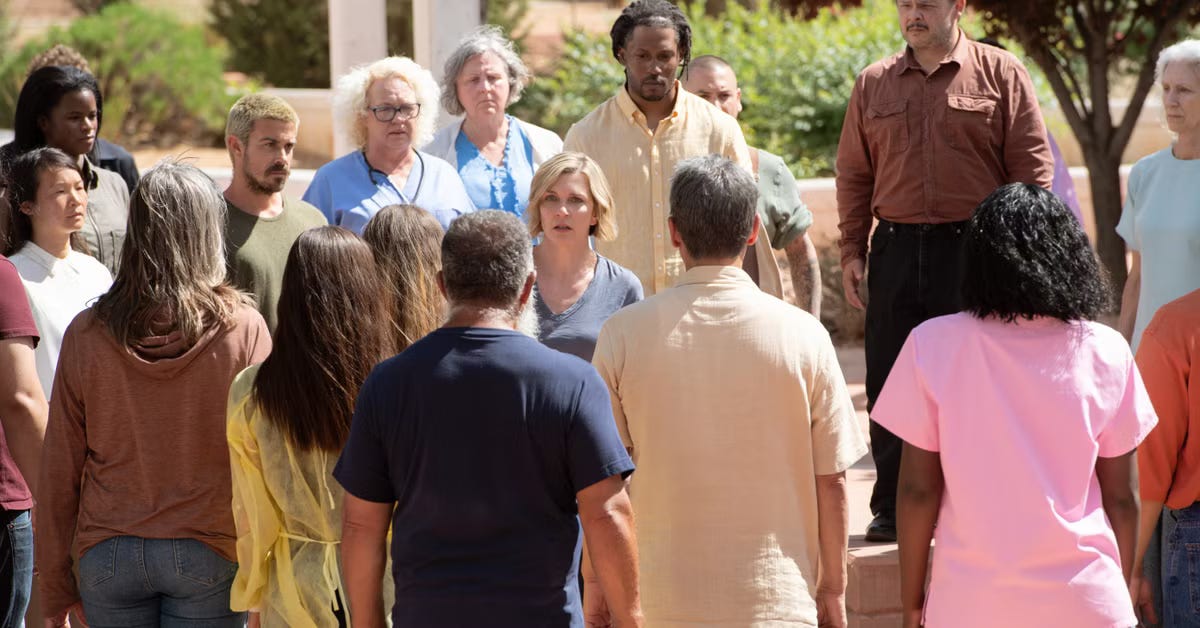
The idea of the ‘hive mind,’ the latest iteration of what used to be called groupthink, has become newly salient over the past decade. It has generated countless memes, along with new epithets for people who don’t seem to think for themselves: the rise of people being called ‘NPCs,’ for instance, non-player characters in video games who control none of the action and show up on the screen in programmed patterns.
The cocktail of media and technology has made the world far more mimetic. We are now so saturated in mimesis that the saturation itself has become the joke — like the 1984 Pepsi commercial that ushered in the age of mimetic irony.
So much of this discourse, though, remains at the level of ideas and taste, and not at the level where it is most insidious: our moral convictions, our conscience.
I sat down with Maddy Kearns, a journalist for the The Free Press, last week for a couple of drinks and a chat about my upcoming book, The One and the Ninety-Nine. (You can read the full interview here, if you’re interested). We covered a lot of ground over the course of two hours, but the one word that came up the most in our conversation—and to which I keep coming back again and again—is the word conscience.
While Pope Leo XIV doesn’t explicitly use the word in his tweet from this past week, he does capture far more eloquently and with more spiritual depth and authority than I could the cultural diagnosis that has been keeping me awake at night and driven the work I’ve been doing on the book for the past two years.
How do we encounter truth that transcends the crowd? Or does our ‘truth’ always happen to be the truth of the crowd that we are most closely aligned with at any given time? I think all of us hope not—but we look at the world, and we see a ‘false conscience’, or what is commonly a hive conscience, prompting people to draw moral conclusions that always just happen to line up perfectly with the decisions they’ve already made. And that seems especially thin when it comes to political decisions and loyalties, like the Vice President’s suggestion that the Pope “be careful” when talking about matters of theology after it became apparent that there was friction between the administration and the Pope’s recent statements regarding war, care for immigrants, and general matters of morality. The Pope’s office involves teaching—but not merely in the way that our middle school teachers taught us math. His office involves forming the conscience, our sense of what is right and wrong.
The hive conscience doesn’t start with 'is this true?’ or ‘what must I do?’. It starts with something base: ‘which team will my words and actions put me on?’ How will my stance on this issue align me with certain groups or interests? And that primary reference to groups, interests, power, and community is precisely where things can begin to go off the rails.
As far as I know, the Pope is not seeking to enter or win any future elections. His relationship to the truth has not been distorted by power. His words are calling many people back to a primordial sense that many have lost, partly due to the media and technology cocktail that has scrambled both intuitions and even our very senses.
Conscience is emphatically not the voice of subjective conviction—the mere feeling that one is in the right. That reductive modern view is precisely what allows people to commit grave evils with perfectly "clear consciences," mistaking the comfort of their own certainty for a genuine moral summons. The older and deeper sense of conscience is rooted in what the tradition calls anamnesis: a primordial memory of the good, inscribed into our nature, which resonates when it encounters truth. Conscience in this sense is not something we construct out of our preferences and feelings; it is something we uncover, and it stands in judgment over us precisely because it points to a truth that exceeds us. The everyday act of moral judgment—what the tradition calls conscientia—is only as trustworthy as the formation of the anamnesis beneath it.1
The connection between memory and conscience has been one of the great revelations of the past two years for me. In the interludes between the chapters of The One and the Ninety-Nine, I tell part of the story of my relationship with my dad, who was diagnosed with advanced Alzheimer's disease as I was beginning the book. Through his illness, and through my care for him, I found myself called back to a deeper conscience, something almost primordial within me. This surprised me. My father did not appear in the original proposal I sent to St. Martin's Press, but he emerged in the writing of the first chapter and never left. His memory, which is bound up with mine, carried moral consequences I did not yet understand when I began writing.
The conscience is how we safeguard ourselves from the tyranny of our own age, or the corruption of the communities we inhabit. John Henry Newman grasped this when he raised his famous toast "to conscience first, and to the Pope afterwards"—not as a declaration of private judgment against authority, but as a confession that conscience is binding precisely because it is the voice of a truth higher than the self, a truth to which even the Pope must answer. Such a conscience is never formed in isolation. It is awakened, tutored, and corrected within a living tradition—scripture, liturgy, the witness of the saints, the slow pedagogy of a community that hands down what it has received. But even communities can become corrupted, at which point their fate rests on the extraordinary witness of those who are still able to sense and respond to a truth which transcends the populism of its members.
I’ve noticed a disturbing trend: people telling others that they have a ‘moral responsibility’ to do something, as if one person’s moral imagination could substitute for another’s conscience.
Last week I tweeted that I had received an invitation from the AI company Anthropic to participate in a couple of days of working sessions at their San Francisco headquarters with other Christian leaders to help talk about their model Claude’s new constitution.
There were various red flags in my initial communication. Anthropic had raised over $30 billion the previous month, but the invitation reached me in the register of a non-profit or church appealing to volunteers' "time, treasure, and talent" for a kind of spiritual mission. The tone was too odd for me. I decided to sit it out, since something didn’t sit right with me about it. (Not to mention it would’ve required a huge sacrifice for my family, with me being away from my newborn and her sister for several days while I was technically on paternity leave—something the company thought was a sacrifice I should gladly make in order to help them.)
When I shared my decision publicly, many understood—but I was still shocked at the number of people, mostly fellow Christians, who implied or even said explicitly that I had a moral responsibility to show up when invited to things like that. Says who? I have a moral responsibility for many things, but I am confident that Anthropic’s invitation is not one of them. This was a prime example of the “hive conscience” at work: a notion of the conscience that is not personal, but collective: “because we are X, we must do Y.” In this case, X is Christian and Y is “be at the table”.
The conscience is the faculty by which we learn to say “I” with moral conviction. It is a step deeper than the comfort of “we believe” statements—it is how we fully own responsibility for what we think and believe, even if others do too: without the coercion and conformity that they want or expect from us. Sometimes, the people doing the coercing are the ones closest to you: your own family, friends, party, colleagues. Usually, they won’t be so explicit about it. The coercion will come in the form of a thousand nudges in the back with the thumb or forefinger, and those who aren’t paying attention may not even notice.
You will notice that the Apostles and Nicene creeds do not begin “We believe”, but “I believe”. And I’d like to suggest that getting to a genuine “I” is the work of a lifetime, but it’s the work that each of us must do—because that same tension plays out in nearly every aspect of our lives, in which we are asked to sacrifice our real conscience to the hive one.
And when you do exercise it, it may not be respected. And that’s okay—do it anyway.
The only tables you are really welcome at are the ones where you can get up and leave freely, and where the invitation doesn't come as an offer we can't refuse.
We can’t learn to respect the freedom of others until we first learn to respect our own: a freedom oriented toward truth over tribe, and one which finds its fulfillment in genuine communion with others who have learned the cost of freedom.
I am not going to suggest that loneliness is a necessary consequence of integrity and truth in today's world, but I will say this—if you feel lonely, do not assume that something is wrong with you; in fact, your desire for a form of real communion that you have not yet been able to achieve may be the very fire that you are called to keep kindled.
If you enjoyed this essay, would you pre-order your copy of The One and the Ninety-Nine today?
Joseph Ratzinger (Pope Benedict XVI), On Conscience (Ignatius Press / National Catholic Bioethics Center, 2007)


