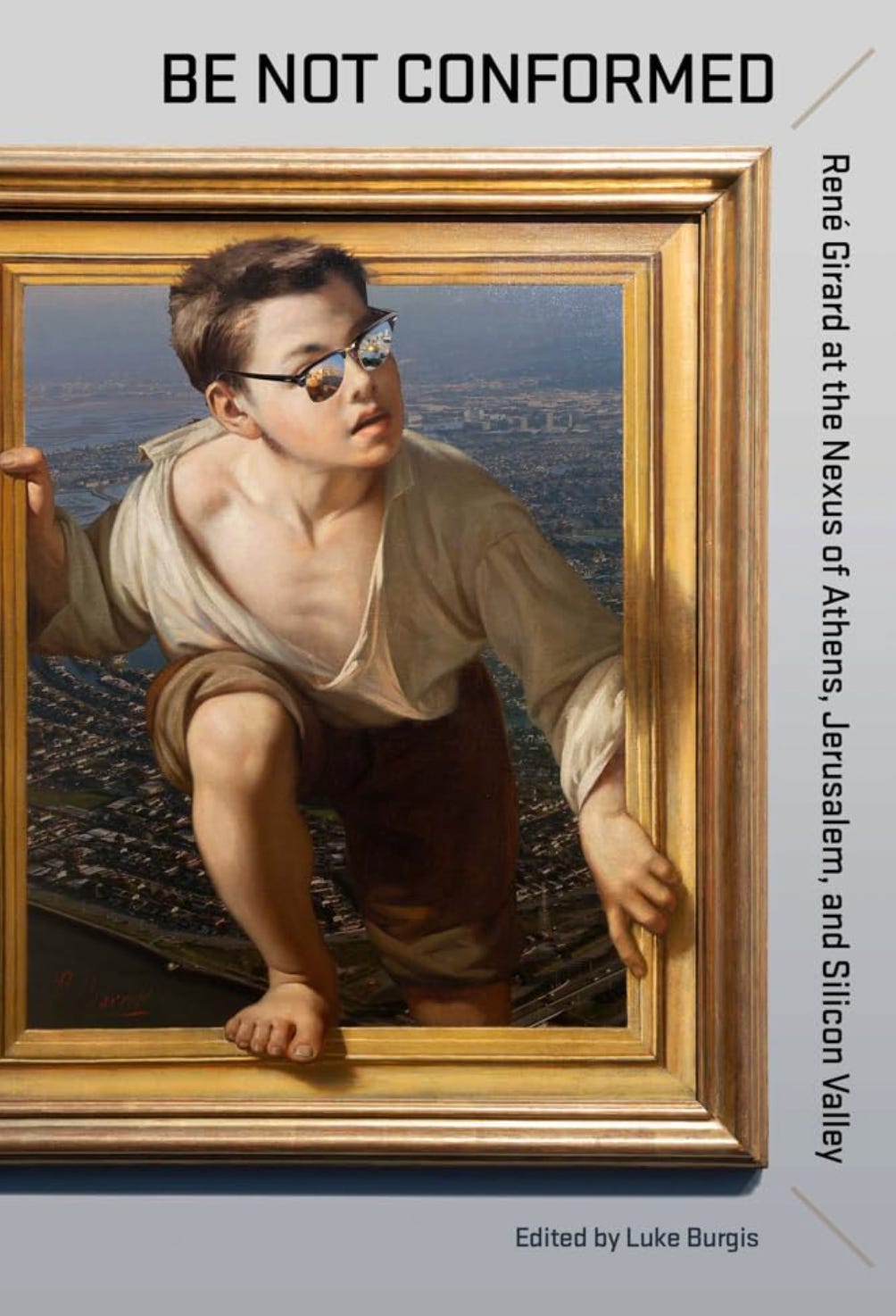
Be Not Conformed—René Girard at the Crossroads
A new book announcement—Updates and Opportunities
Almost two and a half years after the NOVITĀTE conference in D.C. (which celebrated René Girard’s 100th birthday), the book that I promised would emerge from that gathering is finally about to be published. There is much more on the book below—including a detailed table of contents of the 17 original essays that make it up, as well as a bonus preview of the Introduction.
I’m also excited to announce that we are going to be bringing back the spirit of NOVITĀTE with a special session dedicated to Girard and A.I. at the upcoming Zoe conference in Napa this summer, where you can expect to see a lot of the same faces from the 2023 conference—and a lot of new ones.
But before I get to the book: For the next 7 days, the second cohort of the Foundations of Agency workshop is open this spring at a cost of $495.
This is not simply a course that takes you on a survey of the philosophical, psychological, and theological foundations of the concept of agency—it will put you in a small cohort of 4-5 other professionals and act as a forcing function for doing something important that you know you need to do, or will figure out during the course of the 40-day workshop. And it will help you exercise the agency to do it.
I hope to see many of you there. The next seven days are your last chance to apply and enroll.
Be Not Conformed—Advance Reader Edition of the Introduction
Be Not Conformed is out April 10 from Catholic University of America Press and available for pre-order now from CUA Press and most places books are sold.
I’m excited to share with you below my Introduction to the edited volume of essays, along with the Table of Contents so you can see the array of thinkers and writers who make up this volume. I have permission from CUA Press to publish my Introduction here. For the rest, you will need to buy the book.
Here is why you should: While there are many fascinating essays that make it up, and some innovations—including Girard being brought into serious contact with Marshall McLuhan, von Hildebrand, and Liugi Giussani for the very first time, not to mention some apocalyptic (and antichristic! provocations)—it is fundamentally a book that is meant to transform you.
Introduction, by Luke Burgis
The origin of this book is a conference I hosted at The Catholic University of America on November 3, 2023. That gathering, called NOVITĀTE: René Girard at 100, was one of several major events worldwide that celebrated the one hundredth year since the birth of René Girard on Christmas Day 1923. The conference title was inspired by the Vulgate wording of Romans 12:2—“reformamini in novitate sensus vestri” (“be transformed by the renewal of your mind”)—signaling its call to intellectual and spiritual renewal in Girard’s centenary year.1
I began planning about a year early. And then, relatively late in the process—nearly halfway in—I was forced to move the event from its original mid-October date due to joyous but unforeseen circumstances: my wife and I learned that we were expecting our first baby the very same week as the conference. Wanting to avoid the anxiety of hosting an event the same week as the birth, I moved it to the only other date that the banquet venue had available for the entire fall season: November 3.2 Still too close for comfort, but at least not a direct overlap.
After making the change, a friend reminded me that René Girard had died on November 4, 2015; the forced move had resulted in a conference that coincided with the anniversary of Girard’s death. We organized a Requiem Mass at the Cathedral of St. Matthew the Apostle in downtown Washington the morning after the main event. A surprising number of conference participants, Christian and non-Christian alike, attended.
After the high intellectual pitch of the previous day’s talks and panels, and a boisterous party that evening, the mass brought our conference to its conclusion with sacred solemnity. I walked home afterward reflecting on the idea that, for all the grandeur of Girard’s theory, it may have found its highest expression in that liturgy: people standing shoulder-to-shoulder, heads bowed, asking for forgiveness.
Two of the keynote speakers were entrepreneur Peter Thiel, Girard’s famous former student, and Father Elias Carr, a Canon Regular of Saint Augustine from the abbey of Stift Klosterneuburg, Austria. The day featured a panel on race and mimesis with Coleman Hughes, Hollis Robbins, Lester Spence, and Thomas Chatterton Williams, and another on mimesis and media with Substack CEO Hamish McKenzie, author Walter Kirn, and Renée DiResta, moderated by New York Times columnist Ross Douthat. More than sixteen separate panels and presentations took place in concurrent sessions—everything from a Girardian critique of ideology (Geoff Schullenberger) to the Eschatological Problem of Technology (Jon Askonas) to conversations bringing Girard’s ideas into generative contact with Marshall McLuhan, Luigi Giussani, and Dietrich von Hildebrand.
One of the fruits of the conference is the book that you are holding in your hands. We selected and developed many of the essays presented at the conference, and solicited several additional essays related to its theme, to form a cohesive whole. The collection is meant to serve a dual purpose: to reflect on what Girard achieved in the past one hundred years, and to speculate about the potential contribution of his work to the next hundred.
The subtitle of this volume is René Girard at the Nexus of Athens, Jerusalem, and Silicon Valley. Few thinkers of the past century were as multidisciplinary as René Girard. He was a silo-busting figure whose singular, dense insight of mimetic desire blossomed into a rich field of study that spanned the philosophical, anthropological, theological, economic, literary, and more. Girard wrote a book on Shakespeare; a book about Job; another about the apocalypse. He wrote essays about business and innovation, and some of his mentees were renowned entrepreneurs and investors.
Girard was a world-renowned academic, elected to the Académie Française in 2005. He was also deeply Catholic. And, being based at Stanford, his ideas influenced Silicon Valley indirectly perhaps more than any other thinker of his time, through his proteges. When the history of the twenty-first-century Silicon Valley is written, he will have a place in it. Girard is at the nexus of Athens, Jerusalem, and Silicon Valley (which stand for reason, religion, and innovation) because he probed anthropological truths in a way that connects them. That is rare in today’s fractured and fragmented world.
Inspired by Girard’s example and by the integrating force of his ideas, the conference in November 2023 led not only to the publication of this book, but also to the formation of the Cluny Institute in 2024, a multidisciplinary organization dedicated to connecting the “three cities” to build a future that is as meaningful as it is prosperous.3 Girard is one of its intellectual fathers and will continue to shape its evolution.
You will find a diverse array of essays in this volume of different style, substance, and form—some from Girard scholars, and others from writers who are relatively new to his work. That diversity was intentional, and key to the conference’s spirit; however, it may feel jarring if you’re expecting consistency. At the conclusion of NOVITĀTE, someone described it as a mix between a Parisian salon, a party, and a traditional academic conference, without regard to rank or title. I think that’s something Girard himself would have appreciated. There were professors encountering priests and technology entrepreneurs in conversation with novelists. The intention was to bring the greatest energy possible to Girard’s work and let the chips fall where they may. “Be Not Conformed” wasn’t just the theme of the conference, it was the form of the conference—something non-conforming—and the form of this book, too.
On one hand, we all strive to differentiate ourselves; we instinctively want to set ourselves apart, to not conform, especially when we feel our sense of identity under assault. And yet, on the other hand, we can’t entirely escape mimesis. We must ultimately conform our lives to something.
The way out of this conundrum, you will see in this book, starts with understanding that there are different kinds of conformity. The Czech theologian, Josef Zvěřina, a survivor of totalitarianism, saw that it is conformity to the world that leads to negative mimesis—to rivalry, and eventually to violence. In his commentary on the scripture passage from Romans 12:2 (“Do not be conformed to this world, but be transformed by the renewal of your mind, that by testing you may discern what is the will of God, what is good and acceptable and perfect.”), he notes that the Greek word Paul uses for “form” has the root schema. “In a nutshell,” Zvěřina writes, “all schemas, all exterior models are empty. We have to want more.”
When Paul exhorts the Romans to be “transformed,” Zvěřina notes, he uses the word metamorphosis. “He opposes schêma or morphé—permanent form, to metamorphé—change in the creature. A person is not to change according to any model that in any case is always out of fashion, but it is a total newness with all its wealth.”
External models are easy to cling to, but true metamorphosis is a dynamic change from within the creature—and there are not always clear signposts.
And so, this book is not an argument, it’s an invitation: to step outside the ready-made forms of thought, to risk that kind of transformation.
Table of Contents
Introduction
Luke Burgis
Foreword: A Good Contagion
Cynthia L. Haven, National Endowment for the Humanities Public Scholar
Part One: Athens
1. Mimesis and Thumos: A Synthesis of Girardian and Platonic-Scholastic Psychology
Mark Shiffman, Saint Patrick’s Seminary and founding director of the Institute for Philosophy, Technology, and Politics
2. To What Do We Conform? René Girard, Black Studies, and Ayn Rand
Hollis Robbins, Professor of English at the University of Utah (Hollis Robbins)
3. Deceit, Desire, and the Contemporary Novelist
A. Natasha Joukovsky, novelist
4. Girard and the Fictional Self
Marie Kawthar Daouda, author, Lecturer at Oriel College, Oxford
5. Aeneas as Founding Murderer: A Girardian Investigation of the Aeneid’s Close
Annika Nordquist McGregor, OpenAI
Part Two: Jerusalem
6. Escaping the Mimetic Whirlpool: Deceit, Desire, and the Catholic Imagination
Michael P. Murphy, Director, Hank Center for The Catholic Intellectual Heritage and Senior Lecturer at Loyola University Chicago
7. The Analogical Antidote
Trevor Cribben Merrill, California Institute of Technology and author (Trevor Cribben Merrill)
8. Rulers of the World or Triumph of the Cross? René Girard and Dietrich von Hildebrand on: Anthropology, Liturgy, and Resisting Contagion
Michael Matheson Miller, Acton Institute Chief of Strategic Initiatives and Senior Research Fellow
9. Beyond Deceit: Girard and Giussani on the Meaning of Desire
Thomas Deutsch, Theology Teacher at Connelly School of the Holy Child
10. Media and Mimesis: From Imitation to Immolation
Andrew McLuhan, poet, educator, researcher, and founder of The McLuhan Institute (Andrew McLuhan)
11. “We Lepers”: The Mimetic Saint According to Gavan Daws’s Holy Man: Father Damien of Molokai
Fr. Elias Carr, Canon Regular of Saint Augustine of Stift Klosterneuburg, Austria
Part Three: Silicon Valley
12. “Things Hidden”: Mimesis, Technology, and the Apocalypse
Tobias Huber, writer
Byrne Hobart, writer, entrepreneur, investor, and consultant
13. Waiting for Girard: Rivalry, Apocalypse, and Return
Owen Yingling, student at the University of Chicago
14. Against the City of Noise
Justin Lee, First Things Associate Editor
15. The Illusions of Novelty: Belle Delphine and the Eternal Return of Online Fame
Katherine Dee, writer and podcaster (default.blog)
16. The Medium is the Mimesis: McLuhan, Girard, and the Technologies of Imitation
Brett Robinson, Associate Director for Outreach and Associate Professor of Practice at the McGrath Institute for Church Life at Notre Dame
17. From the Passion to the Hydrogen Bomb: René Girard and the Eschatological Problem of Technology
Jon Askonas, Assistant Professor at The Catholic University of America


