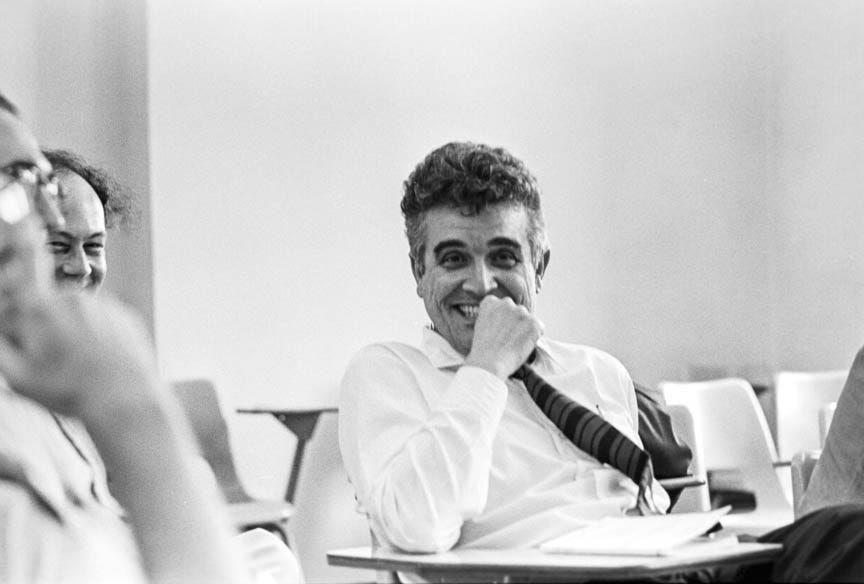
A Good Contagion: René Girard's Influence
Cynthia L. Haven gives a snapshot of the early intellectual movement around one of the most important thinkers of our age.
An excerpt from Cynthia L. Haven—her foreword to the new book, Be Not Conformed: René Girard at the Intersection of Athens, Jerusalem, and Silicon Valley, edited by Luke Burgis, published earlier this month by CUA Press. The edited volume contains 16 original essays on Girard’s work.
Foreword: A Good Contagion
Before he became an acknowledged Silicon Valley guru, before he became the fourth wise man in a Nativity crèche, René Girard lived quietly and inconspicuously on a far-flung corner of campus, on the aptly named Frenchman’s Road. I was fortunate to know René before he was a legend, before he was featured in The New York Review of Books, before he was the subject of a documentary film called Things Hidden, before everybody who was anybody knew him, had read him, or had at least read about him and could quote him or pretend to quote him. My personal encounter with him would prove to be one of the more fortunate moments of my life.
How the Girard movement came together is an interesting story, too, the tale of how a small group drawn from the Stanford community prodded the beginnings of a worldwide movement that would eventually fan out from a circle of academics to the world at large.1 A good contagion, if ever there was one.
René Girard never craved the spotlight, although the spotlight found him more than half a century after his first book, Deceit, Desire, and the Novel, was published in 1961. And the light has only become stronger and brighter since his death in 2015. For me, my interest in his ideas was sparked by a one-on-one encounter before I knew much about him.
At that time, articles and interviews with René in the mainstream anglophone press were virtually nonexistent, and René was pretty much an inconnu in the land he had made a home. I combed through interviews and profiles from Le Monde and Le Figaro, but my French was rusty for the task. I cut my teeth on Achever Clausewitz—the title in English was still being wrestled out and the English proofsheets were under review when I first visited his home on French-man’s Road. The winning title: Battling to the End. Music and the mass brought us together. Decades earlier, I had studied Dante with Stanford Professor John Freccero, a leading Dante scholar, and a close friend of the Girards. That connection led me to the Stanford music professor, William Mahrt; the medieval music in Dante was of interest to both men. A brilliant spiritual, musical, and literary nexus—they’re rarer than we think. The bonus: I eventually met René Girard for the first time, too. He was in a back pew every Sunday at St. Thomas Aquinas Church. The “Carpenter Gothic” church, more than a century old, was familiar to me; I had appreciated Bill Mahrt’s long and tenacious work directing a Gregorian and polyphonic schola, a liturgical cycle of early music that has continued without break every Sunday and feast day for more than half a century. It was not a political statement in a culture war: it was an aesthetic and spiritual stance, with centuries of Giovanni Pierluigi da Palestrina, William Byrd, Thomas Tallis, Josquin des Prez, Tomás Luis de Victoria, and Orlando di Lasso to back it up, and an uninterrupted chain of Gregorian chant going back to the fourth century. I would soon learn that René and I were of the same party in liturgy and books. A world of harmony, order, beauty, and discipline. That was his life, but his work wrestled with the worst of what humanity had to offer: violence, scapegoating, and eventually the prospects of nuclear war.
These polyphonic composers were the basis for our first bond, along with the enduring chant of centuries. “When I first attended,” René wrote to me way back in 2002, “I assumed that the Catholic Church and the University actively supported this unique contribution to the spiritual and cultural life of the community. The truth is that ever since 1963, Professor Mahrt has been very much on his own in this enormously time-, talent- and energy-consuming enterprise.”2
That was my first brief, epistolary connection with René. I was writing about early music and chant and had contacted him for comment.3 It was the first note of an unexpected and unequal friendship. He made a debut in one of my books in 2006.4
At Stanford in 2007, we finally met face-to-face after circling around each other for years. I was invited to attend the meetings of a small Girardian group on the edge of the Stanford campus. I don’t recall how I came to be invited or how this particular eclectic group came together. Elective affinities, perhaps. Molecules pulling people together chemically: like to like.
The group had formed sometime in the 1990s. It convened every two weeks at the Gould Center for Conflict Resolution, a gray-and-white building on tree-lined Salvatierra, off Campus Drive behind the law school. Though there were at least twenty names (at one point, fifty) on the email list for the Genesis reading group (more often called “the Colloquium”)—less than dozen or so would be able to get away from workday commitments for the gatherings on the Stanford campus, settling into the well-worn couches and armchairs upholstered in faded browns and grays.
The discussions were an adventure. In March 2008, René shared his interpretation of the biblical Joseph story. It would have been the first time I heard his unusual take on the patriarch, culminating in René’s surprising claim that the account is history’s first recorded instance of true forgiveness. I haven’t been able to prove him wrong.
The group discussed Heraclitus, Pope Benedict’s controversial Regensburg lecture, and John Henry Newman’s idea of the university. Ken Quandt presented a mimetic theory of Plato. A Paris graduate student in political science visited to explore how to bring mimetic theory to his academic work.
Meanwhile, I was quickly put to work. At the April 2008 Imitatio conference, I conducted video interviews with Italian scholar Giuseppe Fornari, Robert Hamerton-Kelly, and others, as well as René himself. Another discussion considered the Girardian aspects of The Wizard of Oz, based on the deceit of desire. There was a strangeness in being swept up by all of this: I was working crazily to finish journalism commitments at night, and carrying out my Stanford humanities work by day, with a deepening connection with René Girard on the side.
Years earlier, someone told the story of Stanford Professor Jean-Pierre Dupuy, in Berlin with friends, who was confronted and asked why he had become a “Girardian.” The answer, according to the story: “Because it’s cheaper than psychoanalysis.” He had a point.
Robert Hamerton-Kelly, a brilliant scholar and theologian, dominated the conversations, sometimes to the exclusion of everyone else; a big bold man with a pronounced South African accent, a wise and witty (and sometimes abrasive) one-man show. However, when René softly ventured a few comments, Bob deferred quickly: the courtesy of long friendship. Bob’s sidekick, a former Stanford football player named Wayne Larocque, often attended, as did the Voegelin scholar and Hoover Fellow Paul Caringella, theologian Gil Bailie, Plato scholar Ken Quandt, and Byron Bland, a consultant at the Stanford Center on International Conflict and Negotiation and fellow at Stanford’s Martin Luther King Institute. I would meet more members of the group in the weeks to come.
René also attended regularly—the star, a supporting player, and audience all at once. By then he was in his mid-80s and his energy was already ebbing, eight years before his death. But he was still an inescapable presence, still the reason that we were there. I observed his self-effacement, his modesty—he declined to dominate, even when he could have, even when we wanted him to be the boss. Finally, there was an intense young man of about forty with penetrating, pale blue eyes. He sat on the floor, legs akimbo, wearing running shoes before running shoes were a thing. That, someone whispered to me, is Peter Thiel. So it isn’t too much of a reach to say I studied René Girard with Peter Thiel, though I don’t recall ever exchanging so much as a greeting with the legendary entrepreneur in all my visits to the Gould Center.
Thiel’s interest in René’s thought was not about making money but rather understanding himself and his motives and assessing the times—that would be true of just about everyone who seriously engages with Girard’s ideas. As a young man in a New York law firm, Thiel remembers all the lawyers competing for the same goals. They measured themselves by their progress within their peer group, not any transcendent objective.
When I left the firm, after seven months and three days, my coworkers were surprised. One of them told me that he hadn’t known it was possible to escape from Alcatraz. Now that might sound odd, because all you had to do to escape was walk through the front door and not come back. But people really did find it very hard to leave, because so much of their identity was wrapped up in having won the competitions to get there in the first place. —Peter Thiel5
Later, Thiel would focus on global warming and fossil fuels, apocalypse, immortality, and the future of democracy. His thinking followed the profoundly interdisciplinary directions and patterns modeled by René himself, though his preoccupations were of an entirely different hue. René’s theories weren’t fashionable and, in some cases, could be a career-killer. But not for Thiel.
Bologna-based anthropologist Mark Anspach, then an undergraduate at Harvard, wasn’t so fortunate. René Girard had warned him that mimetic theory was a risky career choice. One advisor told him that citing Girard in his senior thesis was “batty.” Anspach recalled the event ruefully: “It wasn’t a criticism of what I was doing; it was criticism of Girard. He said this guy’s ideas are dotty. That word stuck in my mind—you know, ‘dotty.’ It was dotty.” He complained to Harvard about the unfairness, arguing that once the faculty had approved the subject of his thesis, it was out of bounds to criticize him for writing about it. Rather they should critique his work on its merits. Such was Girard’s reception in academia. And for many years, the scholarly exile would continue. Girard’s theories are only beginning to find acceptance in academia, though his entire career was in American universities.
The point: I assumed back then I was entering a well-established circle of old-timers, long familiar with Girard’s work. That wasn’t the case—or at least, not entirely. I realized only much later that I was there at the beginning, not knowing it was a beginning. And everyone else was finding their way, too.
The Gould Center fostered a colloquium of Girardian novices at various stages of initiation. Everyone was learning and is still learning. The arc extends beyond our lifetimes, which puts a different scale on the notion of “beginning.” Almost all of us were new, or relatively new, to Girard’s thought—with the obvious exception of Robert Hamerton-Kelly, who met René in 1981. Though he was theoretically one among equals, his longstanding friendship with René and his clout at Stanford brought the colloquium into being. He was dean of the chapel at Stanford and also one of the cofounders of the Colloquium on Violence
Hamerton-Kelly usually offered an article or paper for the discussion at the Gould Center. Others did, too. I remember, in particular, English Professor Bernadette Waterman Ward of the University of Dallas presenting a paper on Adam Bede and mimetic angels in George Eliot’s novels.6 Women were still something of a novelty in the group then—so her appearance was cheering and so was the discussion around her paper. I recall an Imitatio workshop on neuroscience, a discussion of the Regensburg lecture, a visit from a PhD candidate in political science from Paris who was using mimetic theory in his research, and a large, splashy lunch at the tony Il Fornaio restaurant in downtown Palo Alto, with San Francisco Archbishop George Niederauer as a guest of honor. That was Bob Hamerton-Kelly’s style and influence.
How was this conclave different from the other, more academic or corporate models of organization that were already coalescing around Girard? It was not a society, not an association, but rather a colloquium: that is, focused academic discussions with an in-depth consideration of René’s work. Professional societies also began to form, along with academic sessions where formal papers were given—but the growing Girardian movement hadn’t yet reached the worldwide audiences most in need of Girard’s message of reconciliation, forgiveness, and the utter abandonment of violence and retaliation. Girard was unequivocal and yet ambiguous: “The time has come for us to forgive one another. If we wait any longer there will not be time enough.”7 Time enough . . . for ourselves, for the world? Time enough to escape the apocalypse we’re preparing for ourselves? René left the possibilities open for good reason. Each one of us faces our own apocalypse, our own personal mortality. Perhaps we focus on big worldwide cataclysms to avoid coming to terms with it.
In those years, Imitatio was just beginning to sponsor research to pro-mulgate René’s concepts and legacy. Few of us anticipated that we would be recipients of its largesse. We were drawn to René’s work because it spoke to us, and to the world.
Elaborating and applying Girard’s concepts can’t be entirely a solo operation, a “head trip.” Hence organizations like the Colloquium on Violence & Religion. His concepts must be enacted in community, in concert with others. After all, it’s a social theory, not a self-help scheme, though all of us have found applications to our own lives. We are the experiments. We are the guinea pigs.
No one came to the Gould Center because it was the smart and up-to-date thing to do. Rather, like Peter Thiel and his running shoes—he wore them because it was the most convenient way to get to Salvatierra Street, not because he was trying to impress us with his savoir faire and nonchalance in a room of older academics. If it was cool, maybe it was because he seemed cool and unknown. Not a fashion statement, but his way of being true to himself and the world. He was onto something—and we sensed it was valid.
Mimetic independence creates a mimetic reaction from the people around us—but it is a good contagion. René was a model for many of us: we wanted to be like that guy; we wanted to understand what he understood. He had something to say that’s compelling. We were motivated by what, years later, Luke Burgis would call a “thick desire.” The thickest possible.
And that was the point: we were not just talking about breaking away from mimetic desire. We were demonstrating how to do it.
Inevitably, friction sparked among the players—people are prone to conflict, after all—but also a surprising joy and relief. It was the beginning of a growing movement. Nobody was in it for getting rich or getting tenure. Some lost social standing and prestige for taking up with an unconventional Frenchman, others dropped out of grad school. In Paris, Benoît Chantre lost his job as a publisher. Others switched their careers, or their college majors, or moved across the country or world. “You had a sense of a bunch of losers, but it was a lot of fun,” Trevor Merrill recalled. He compared it to one of those science fiction stories where people with no apparent affinities hear an unusual summons to gather, forming a disparate group of oddly assorted people with an all-encompassing mission.
In short, the reasons for being there were not mimetic. We were not driven by what the cool kids were doing. To the contrary, you had to abandon the cool kids to get in the space where you could understand what René was driving
No one was making a buck off this. There were no books pouring out of publishing houses, no seminars, no conferences. No one was interpreting Girard’s work because we were still learning his work. No one was getting tenure or doctorates or prizes because of mimetic theory. Podcasts and talking-head Zoom videos did not exist. Girard wasn’t yet in a New York Times crossword puzzle or mentioned on White Lotus—that was in a future he didn’t live to see. What he offered instead was the truth of humanity’s condition, the reason for our inhumanity, and a way out of madness.
The measure of success happens within the heart of each person. The theory has succeeded when we halt before an envious or snide remark, when we decline to join in a vindictive and personal attack on a rival, or when we resist the temptation to pour invective on a figure only seen on social media.
Here’s the kicker: I can’t remember a single word anyone said at any of those hours and hours of meetings decades ago.
What was happening in the room was more important than what was being said inside it. Words disappear with time, but the lessons linger. Consider: one of the wisest men in the world sat to the side, silent and humble. One of the richest men in the world sat on the floor.
And Robert Hamerton-Kelly—I remember his soliloquies as he talked wisely, wittily, not even stopping to inhale. Talking so long that people were no longer listening but merely waiting. And just when you were sure he couldn’t be more pompous if he tried . . ., he paused. His face crumpled in embarrassment as he began merrily laughing at himself, in front of the whole group. He was onto Bob Hamerton-Kelly. The unexpected self-recognition and disconcerting humility were worth the price of admission. That’s what I remember. Not the words, but the laugh. It taught me more than a bucketload of words.
René Girard’s reception in his native land was a whole different story. His books have a far wider fan base in France, a country with a far richer ecosystem for intellectual life and activity . . . yet France, too, has issues of its own with its Americanized native son, who did not climb the rigid French ladder to academic acceptance.
Cynthia L. Haven, email correspondence with René Girard, December 24, 2002.
Cynthia L. Haven, 1 “On Wings of Song,” Stanford Magazine, March/April 2003, https://stanfordmag.org/contents/on-wings-of-song.
Cynthia L. Haven, ed., Czesław Miłosz: Conversations (University Press of Mississippi, 2006), 22, 23. Nobel poet Miłosz had apparently been reading To Double Business Bound: Essays on Literature, Mimesis, and Anthropology (Johns Hopkins University Press, 1978). “The last book I read was a book by a French—how should I call him? I don’t even know what term to use—scholar, René Girard, who is a polemicist with the anthropology of Levi-Strauss, and of Freud also, by the way. It is good to know such things, but better to forget them when one is writing a poem.”
Peter Thiel, Commencement Address at Hamilton College (May 22, 2016).
The paper was eventually published as Eliot’s Angels: George Eliot, René Girard, and Mimetic Desire (University of Notre Dame Press, 2022).
René Girard, 1 The Scapegoat, trans. Yvonne Freccero (Johns Hopkins University Press, 1989), 212.


